
Sunday, 20 October 2024

Sunday, 13 October 2024
Can I Come Too (1979)

I'm of
the generation that just about remembers the tail end of the fleapit cinema
era...the broken down seats, the thick cigarette smoke penetrated only by the
light from the projection booth, the usherettes selling ice cream and Kia-Ora
in the intervals, the Pearl & Dean adverts. If you want to know what a down
on its knees local cinema looked like in the late 1970s, Ray Selfe's 'Can I
Come Too' takes you around every nook and every cranny of a fleapit cinema.
In his
later years, Selfe was critical of the David Hamilton Grant films he was
involved with, due to their avoidance of the three-act structure. Yet, Can I
Come Too, the short sex film Selfe made outside of Grant's orbit, is very much
cut from the same cloth. It's a shambolic, ensemble piece that barely goes
anywhere in terms of narrative, and owes its existence to the fact that a
distributor urgently needed a support feature. New Realm put out Can I Come Too
as the co-feature to their Jackie Collins adaptation The World is Full of
Married Men. A few years later, in the early days of videotape, it formed half
of a VHS double bill with James C. Katz's striptease documentary The Rise and
Fall of Ivor Dickie (1978).
As with David Hamilton Grant movies like Under
the Bed and The Office Party, Can I Come Too is closer in spirit to a sitcom
episode than a feature film, but with the kind of nudity and sexual humour that
you couldn't get on TV back then. The creation of Can I Come Too appears to
have mirrored what little plot there is here, sex film producer Manny Glowpick
reaches out to his contacts in the low end of the film industry in order to
stage a lavish film premiere at the less than lavish Savoy cinema in Brixton.
Selfe likewise looks to have put together his film with similar haste, calling
on friends and family members to pose as actors, hiring a few aging
entertainers to do their thing and a few dolly birds willing to bare all. The
involvement of the latter possibility being a motivation in ensnaring the former.
For a near plot less 38 minute film, Can I Come Too sure has allot of
characters to contend with. The out of their depth staff making a hash of
arranging the premiere includes manager Mr. Royal (Charlie Chester), cleaning
lady Laverne (Rita Webb), ticket lady Vera (Sue Longhurst), and a pair of
usherettes (Lindy Benson, Maria Harper) who dream of starring in movies like
'King Kong meets Emmanuelle'. Meanwhile projectionist Terry (Graham White)
fears that the arrival of a new projectionist called Charlie will cramp his
style as the cinema's resident stud. Only for Charlie (Julia Rushford) to turn
out to be female, who despite being a womens libber isn't averse to getting her
boobs out in the projection booth either. Elsewhere porn star Gloria Overtones
(Susan Silvie), the special guest of honour, is more concerned with leaving a
good impression on her posh future mother in law, Lady Wickhampton (played by
Selfe's wife Jean), who initially mistakes Gloria for a black woman after
catching Gloria wearing a mud-pack and hearing she is from Brixton.

Such is the obscurity of Can I Come Too these days that it is likely to only be tracked down and seen by the most dedicated of those with a jones for 1970s British pop culture. The irony is that the film itself in no way, shape or form shares that love for the time period it was made in. For all of the tits and intended giggles here, there is much despair in Can I Come Too at the state of Britain in 1979. In the eyes of Can I Come Too, cinemas have just become places for old people to sleep in and keep warm, the world outside of the Savoy is the dangerous stomping ground of football hooligans and punk rockers, the sex films that British film industry churns out are an embarrassment and it gets teary eyed for the past, with Rita Webb's character lamenting the passing of an age of proper movie stars like Jean Harlow and Mary Pickford. It's a backwards looking, living only for the past film, never likely expecting that its own era of British sex films, football hooligans, fleapit cinemas and punk rockers would one day exert a similar fascination over future generations. Young bare flesh might be the main selling point, but the characters that Can I Come Too really cares about tend to be the middle aged or senior ones. All of whom have an air of wasted, unfulfilled lives about them. George Skinner (Tony Wright) the owner of the restaurant next door to the cinema is estranged from his daughter and is in the doldrums over his business going down the pan. Laverne, played by Rita Webb, is a tragicomic character who wanted to be a glamorous movie star, but makes do with her pathetic connection to the movies, of being a cleaning lady at a fleapit cinema. Unusually for a British sex comedy the running theme here is finding love in later life. Freddy (Mark Jones) the bumbling film publicity man with an extreme stutter that anticipates Michael Palin in A Fish Called Wanda by a few years, becomes besotted by ticket lady Vera, played by Jones' Keep It Up Jack co-star Sue Longhurst. Senior sparks begin to fly between Laverne and Manny, while George Skinner is unexpectedly reunited with his ex-wife.


It is the older hands who largely shine here. Admittedly Chic Murray seems to be phoning it in and doesn't have the same vigor he had in The Ups and Downs of a Handyman, but Charlie Chester is value for money and Rita Webb is the person that Selfe clearly regarded as the real star of his movie.
Murray and Webb were by this point veterans of saucy cinema, but Charlie Chester was more of a coup, the comedian's career having largely been played out on the radio. While his appearance here might have raised the eyebrows of his older fans, Chester was no stranger to sleaze. Turning to a writing career in the 1970s, Chester knocked out sex and violence fuelled books for publisher New English Library that were completely at odds with his family friendly image. Symphony and Psychopath (1975) concerns auto-erotic asphyxiation, Soho prostitution and the murder of a pregnant woman, and also sees Chester boning after schoolgirls in print. In comparison being in close proximity to a few bare boobs in Can I Come Too must have seemed a relatively vanilla experience. Under a pseudonym, Chester even wrote a gay themed serial killer novel called Even the Rainbow's Bent (1977) in which a sexually confused man is encouraged to adopt a female persona by his domineering mother, only to end up killing schoolgirls.
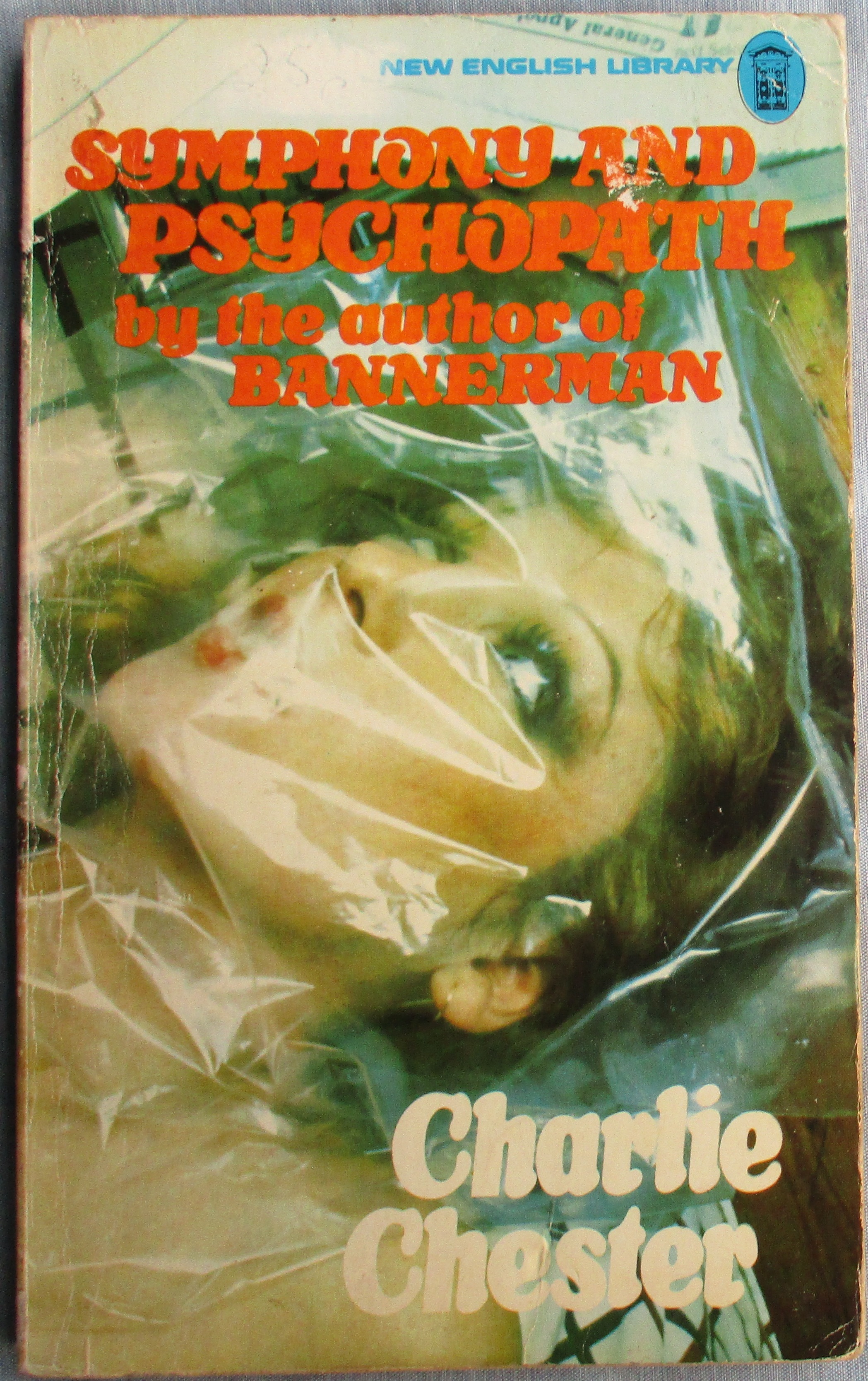

a right pair of charlies
The younger cast members of Can I Come Too are
less of a standout bunch, consisting of third tier sex comedy people like Lindy
Benson, Maria Harper and Vicki Scott, all of whom arrived too late on the scene
to make much of an impact on it. One movie and he's done stud, Graham White,
looks like he'd have been better suited to playing Dr. Frank-N-Furter’s
creation in The Rocky Horror Show. Given a larger share of the spotlight than
usual here is Susan Silvie, who was sort of the poor man's Suzy Mandel, though
did later achieve a degree of notoriety by playing a woman who gives birth to a
fully grown man in the sci-fi grossfest 'Xtro'. In Can I Come Too, Silvie
looks, sounds and dresses so much like Suzy Mandel it is positively uncanny,
and she would later add to the illusion by billing herself as Susie Silvie. To
add to the confusion, the film Blonde Ambition starring the real Suzy Mandel
was released to UK cinemas in 1984 as 'Can I Come Again', making it sound like
a sequel to Can I Come Too, starring the Suzy Mandel equivalent of Bruce Le.
Keep your eyes peeled for a 'blink and you'll
miss her' appearance by Annette Poussin. Distinguished by her cute, pudding
bowl haircut Annette was a regular in blue movies like 'No Morals' and 'Pop
Concert'. Her fleeting cameo, and the fact that Selfe himself was no stranger
to hardcore pornography, opens up the possibility that a stronger version of
Can I Come Too might exist. While a potential 'something blue' aspect to the
film is still a question mark, there is plenty of evidence of 'something
borrowed' here. The film recycles a joke about a fictional movie called Sore
Throat, a pun on Deep Throat, from 1975's Sexplorer, and John Shakespeare's
theme tune was a track dusted down from his soundtrack to the 1966 movie 'Death
is a Woman'.
Aside from Selfe, whose oeuvre includes the
early David Jason vehicle 'White Cargo', a Kenny Ball concert film and 'Mother
Goosed', a videotaped adult pantomime, the other auteur of Can I Come Too was
Alan Selwyn (1926-2002), it's writer and producer, who also takes a small
acting role in the film. A jack of all trades in the British sex film world,
Alan Selwyn was very much a man created by Soho. His birth name was Alfred Lopez
Salzedo, and his father Solomon who used the professional name of Sidney
Brandon had been an entertainer at the Windmill theatre, meaning that Selwyn
had been around sex, showbiz and criminality from an early age. He was
originally a bit part actor, and shows up in a few early Ken Loach films like
Poor Cow and Cathy Come Home. At some point in the sixties Selwyn did prison
time, seemingly for defrauding a man in the theatrical world, who Selwyn's sister
worked for. The sister, who played no part in the fraud, was so ashamed by her
brother's actions that she felt obliged to resign from her job, and as a result
rarely spoke to her brother again. Unaware that he had predeceased her, her
will made a special proviso that none of her estate should go to her brother
Alfred, 'also known as Alan Selwyn'. Which is how his surviving relatives came
to know about the Alan Selwyn side of his life and his connection to the movie
industry. People's memories of Alan Selwyn tend to be that of a real life
Arthur Daley figure, a man from the shady side of the street, who nevertheless
wasn't without a moral compass. Suzy Mandel has good memories of Selwyn, and
Annette Poussin regarded him as a gentlemanly, father like figure who actually
dissuaded her from taking larger, credited roles in sex movies on account of
the possible negative consequences it could have on her private life. In the
name of honesty and full disclosure though, it should be pointed out that not
everyone remembers Alan Selwyn so fondly. He is the subject of a #metoo story
in Cosey Fanni Tutti's autobiography, where she claims Selwyn tried to rape her
backstage during the making of Secrets of a Superstud. "Once in the
dressing room, I fell asleep - and prey to Selwyn's unwanted attentions. He
soon got off me when I told him I'd started my period". I will say that
story is completely at odds with what other women have told me about Alan
Selwyn, but that is what Ms. Fanni Tutti wrote.
There is an end of the line feel about Can I
Come Too, remember that last day of school? this is the British sex film
equivalent. Everyone here is letting their hair down, not doing much serious
work and partying with the people they've got to know well over the last couple
of years, in the knowledge that they are never likely to see each other again.
Something that is added to by a scene towards the end of the film, where this
gathering of British sex film people gets down on the dance floor, with some
exceptional dad dancing from Mark Jones that causes Alan Selwyn to crack up. It
was the end of an era, but it's not over till the fat lady yells. I do wish
that Can I Come Too had been Rita Webb's last film. The final shot in the film, a freeze frame of
Rita throwing her cleaning equipment away and yelling "SOD IT, let them
clean the place up themselves" would have been such a Rita Webb way of
saying goodbye, and likely reflects Ray Selfe's own attitude to the British sex
film biz...sod it, let them clean this mess up themselves.
The real success story of Can I Come Too isn't
in fact anyone in front or behind the camera, rather it's the cinema itself.
Referred to as The Savoy in the movie, it was in fact the Ritzy Picturehouse in
Brixton. Can I Come Too captures this location at the lowest point in its
history, and watching the film you'd be forgiven for thinking that it had long
since been bulldozed. Following a 1994 renovation though, the Ritzy has bounced
back from its inglorious state in the 1970s and is now considered the jewel in
the crown of London's surviving cinemas. It's aged better, and more elegantly
than those football hooligans, punk rockers or indeed Can I Come Too itself.

Sunday, 6 October 2024
Blood Suckers (1969)

I recently read the source novel for the first
time, which is advisable if you want to make sense of the film as there is so
much more characterization, psychological depth and general meat on the bone in
the book. In comparison the film is like a jigsaw puzzle where many of the
pieces are missing, and those that are present don't actually fit together all
that well.
Doctors Wear Scarlet concerns Richard Fountain, a
promising young Oxford Don who effectively flees to Greece in order to escape
the domineering influence of his provost Walter Goodrich, who is grooming
Richard as both his successor and as a fiancé to his daughter Penelope. While
in Greece, Richard falls under the influence of a sultry temptress called
Chriseis, who draws him into her world of vampirism and the occult.
Necessitating that Richard's friends, Piers Clarence, Captain Roddy Longbow and
Anthony Seymour travel to Greece in order to extract Richard from the Chriseis
situation and avoid a scandal. Vampirism aside, it had clear autobiographical
elements for the notoriously caddish Simon Raven, whose career in the military
and higher education was marred in controversy, and no doubt had his own run
ins with the Walter Goodrichs of this world. Pears Clarence is likely based on
Raven's younger companion Bungo Partridge. While the anti-Semitic incident that
is in the book, but isn’t ported over to the film, likely relates to Raven's
publisher Anthony Blond, who was Jewish and is said to have suffered badly on
account of it whilst at Eton. Reflecting Raven's personality and tastes,
Doctors Wear Scarlet is all about the allure of scandalous men. Richard's
motivation for striking up a friendship with Piers is the trouble that will arise.
Similarly Richard himself proves to be source of much male adulation, due to
the aura of controversy that surrounds him. Marc Honeydew can't get enough of
watching Richard's conflicts with Walter from the sidelines, and Richard first
comes to Anthony Seymour's notice by beating up an anti-Semitic school bully.
An incident that marks Richard out as the man Anthony wants as his study fag.
Boys will be boys, and play with toys, so be strong with your beast.
Judging by the book, I'm guessing that production
of the film ran into problems once it left Greece and relocated to the UK. The
Greek portions of the film follow the book relatively faithfully. It is the
first and third acts of the film set in the UK, where so much has clearly gone
unfilmed and what they did get in the can was awkwardly pieced together. About
the first 100 pages of the book are compressed into the first couple of minutes
of the film. It would really need a TV miniseries to do justice to the story of
Richard Fountain. Short of giving you his inside leg measurements, the book
goes into every aspect of his life, his military service, his adventures in the
Congo, his days as a Study Fag, his antagonistic relationship with Walter
Goodrich. I think where the film initially drops the ball is how little of
Walter Goodrich there is in it. We never see enough of Walter to understand why
Richard hates him so. Whereas in the book, Walter is a manipulative, ruthless
control freak with a need to dominate every aspect of Richard’s life. The first
time the word ‘vampire’ is mentioned in the book, isn’t in relation to
Chriseis, it’s in relation to Walter wanting to drain Richard of his
individuality and have Walter’s personality flowing in Richard’s veins instead.
Richard escapes to Greece, but he only succeeds in jumping from one unhealthy,
domineering relationship to another, replacing Master Walter with Mistress
Chriseis. Another shortcoming to the film is how little there is of Marc Honeydew,
who in the book is this wonderfully waspish old queen who thrives on other
people’s conflicts and gossip, particularly that of a sexual nature. ‘Mother
Honeydew’ as he nicknames himself, might well be my favorite character in the
book, and one you strongly suspect Simon Raven had much fun in writing. Yet,
you see so little of Honeydew in the film that the actor who plays him, William
Mervyn, might as well as not bothered to show up on set. Which is frustrating
because you sense that Peter Cushing had a Walter Goodrich performance in him.
While Mervyn had played a very Honeydew type role in a TV series called ‘Mr.
Rose’, so it’s a certain he had a Marc Honeydew performance in him, but either
Hartford-Davis didn’t get it on film, or it ended up on the cutting room floor.
I will say that the film is well cast, and if you see the film first then read
the book, you will have Patrick Mower in your head when you read about Richard
Fountain, you will have Peter Cushing in your head when you read about Walter Goodrich,
right down to cast members like Imogen Hassall and Edward Woodward, even though
they don’t match up to how their characters are described in the book.
A radical departure from the book, which the film
makes, is to drop the character of Piers Clarence and replace him with Bob
Kirby, an African student of Richard’s. A very early example of race swapping
in movies. Although I don’t think this is out of step with the Richard Fountain
of the book, who gravitates towards Piers because people think that they’re a
pair of gays, which causes problems for Walter who is trying to pair Richard
off with his daughter. So, I can buy into the idea of Richard befriending a
black man, because it turns heads, because it rattles the cage of the
establishment. The Congo section of the book, and the language Raven uses
there, does inadvertently illustrate amount the racial prejudice around in the
circles that Richard would have travelled in. Since there is so little
back-story in the film though, I don’t think you really get the sense that
Richard’s relationship with Bob is another way of him striking back at Walter,
which is I suspect why Hartford-Davis cast a black actor in the role.
Considering that this was an era when racially themed films like 'To Sir, with
Love' and 'In the Heat of the Night' were big box-office, something an astute
character like Hartford-Davis would have been aware of, very little is made of
Bob’s skin colour….unless you speak Greek. From what I’m told the Greek
language yelling that the old woman does in the scene where Bob gets beaten up
by the Greek thugs is extremely racist, and would never have made it onto
British TV, had anyone at ITV understood Greek. That scene is also the subject
of one of my all time favorite, unintentionally hilarious front of house
stills, which depicts one of the Greek guys charging into Bob’s mid-section and
Penelope becoming hysterical in the background. Trouble is that, what with
Bob’s facial expression and the Greek guy's head being buried in Bob’s
crotch….at the risk of sounding like Marc Honeydew….it does rather look like
Bob is getting a blow-job. Which is doubly-unfortunate given that….again at the
risk of sounding like Marc Honeydew…someone connected to this film is rumored
to have died whilst being fellated. No names from me, but I’ll put everyone’s
mind at ease by saying it wasn’t Peter Cushing.

A couple of Hartford-Davis’ other casting decisions have an air of favoritism to them. By having Penelope Goodrich along for the Greek trip, rather than keeping her in the UK as per the book, he was able to increase the screen time of Madeleine Hinde, an actress he was into promoting at the time, and the star of his previous film ‘The Smashing Bird I Used to Know’. This does feel like a betrayal of Simon Raven’s book and its boys only attitude of ‘tally ho chaps; we’re off the Greece to rescue dear Dickie from the clutches of a beastly woman’. You can tell from the book that Raven was the product of a predominately male society, where women were largely excluded or regarded as a nuisance, Raven does have a wicked fondness for comparing Penelope Goodrich to a cow, dumbly grazing at social occasions with her heaving bosom and ‘cow eyes’. Hartford-Davis also always loved to use David Lodge in his movies, so comes up with an entirely new character, Col. Stavros, in order to shoehorn Dave Lodge in there. However Lodge is far less memorably utilized here than in Hartford-Davis’ earlier film Corruption. You’ll leave Corruption never being able to forget Lodge’s character in that, I don’t think you can say the same about Col. Stavros.
Although the passing of time has likely robbed the book of its freshness, in its day Doctors Wear Scarlet must have been a game changing work that freed the subject of vampirism from its Gothic trappings and explored its relationship with sex and sadomasochism. In the book, Richard is drawn to vampirism due to his need to be dominated, due to his inability to have regular sex. The film makes those connections to an extent, but the book also draws comparisons between how victims of vampirism can go onto take on the vampire role themselves, in the way that the victims of sexual abuse can often go on to be abusers themselves. This is made clearer in the book, especially as there are scenes of sexual abuse in it, which would be completely unfilmable. Wild, gratuitous and random as the ‘psychedelic orgy’ scene in the film is, that’s vanilla compared to what its standing in for in the book. In which Chriseis encourages parents to sexually abuse their children, in order that she can then drink the blood of fleshly corrupted children.
After reading the book, you have to wonder how anyone thought there was a film in it, Doctors Wear Scarlet is a stubbornly un-cinematic book. Very leisurely placed, very much a raconteur’s book, mainly related in the form of anecdotes, conversations, personal correspondence and even poems. Even the title doesn’t lend itself well to a film, Doctors Wear Scarlet is the kind of enigmatic, cryptic title that a book can get away with, but film titles generally have to be bolder, and more forthcoming about what they are selling. Very much in the way that ‘Do Androids Dream of Electric Sheep?’ is a great book title and ‘Blade Runner’ is a great film title, but it wouldn’t work the other way around. I can’t imagine a film called Doctors Wear Scarlet would do much business at the Drive-Ins or the horror section of VHS shops, on the other hand I struggle to imagine Simon Raven using Bloodsuckers as a book title, even Incense for the Damned would likely have sounded too schlocky, and unbecoming to the likes of him.
Maybe Hartford-Davis just fancied a holiday in Greece, and adapted the nearest Greek themed book he had to hand. I’ve often thought that Hartford-Davis had a shooting style that falsely suggests he had a background directing ITC shows. He didn’t, but in his hands Doctors Wear Scarlet does end up looking like an episode of The Saint, The Protectors or if you’ve feeling ungenerous The Adventurer…sunny foreign holiday location work and manly fist fights are the order of the day here. An illusion that’s added to by the casting, which leans towards small screen heroes. Alex Davion was the co-star of Gideon’s Way, William Mervyn was Mr. Rose, Patrick Macnee was John Steed, and Edward Woodward is here taking a break from Callan. Even Patrick Mower was destined to be more of a TV heartthrob than a movie star. In his autobiography, Mower tells of how Imogen Hassall successfully won a £10 bet with several crew members that she could sexually arouse Mower during their love scene. “Method actor though I am, a block of ice I am not. And Richard the prig was becoming Bruce Banner- only it wasn’t the Hulk that was growing larger”. Although the camera operator stiffed Hassall on full payment, remarking “call that a stiffy? I’ve seen more meat in a Potato pie; I’m only paying a fiver”. Mower also recalls being vigorously pursued by a Turkish belly dancer during the making of the film, who ‘gave me one of the best nights of sex in my life’, only for it to emerge that she had mistaken him for Patrick Macnee. “I only make love to the star of the film” she told Mower after whacking him around the head. As much as Bloodsuckers has its fair share of name actors, Hartford-Davis did have a Michael Winner like talent for spotting up and coming talent and putting them in films they’d later come to regret. Maureen Lipman famously hates the Hartford-Davis film she is in, The Smashing Bird I Used to Know. Writing about the same film in his autobiography, Mower recalled him and Dennis Waterman getting shitfaced drunk after seeing The Smashing Bird I Used To Know, on account of it being “such an unmitigated load of old tripe”.
I still have a bit of nostalgia for Blood Suckers, it takes me back to a time when I was discovering then obscure and undocumented movies on late night television. After exposing myself to the source novel, I do now have a greater understanding of what the film was trying to say, but I also have to concede that they did make a pig’s ear of saying it, and it is difficult to forgive the film for its lack of Marc Honeydew.
For a 1960 book, Doctors Wear Scarlet was ahead of its time in many respects, and likely felt more relevant when the film was made in 1969. What with its themes of disillusionment with the older generation, young people dropping out and seeking freedom, only to discover that the counterculture itself had a dark side. Chriseis is a warning that those in Charles Manson’s obit should have taken heed of. Choose your gurus, and study fags, wisely. Not all Greek women are as nice as Nana Mouskouri.


Monday, 30 September 2024
Black Abductor (1972, James Rusk, Jr)
This summary is not available. Please
click here to view the post.
Saturday, 7 September 2024
Black Uprising (1976, Joseph Nazel)

Another knockout book from Joe Nazel. Black Uprising is a sort of sequel to 1975's Death for Hire, in that it brings back Spider Armstrong. A character who was clearly close to Nazel's heart, and of all of his protagonists is the one that likely offers the greatest insight into Nazel himself. Spider being an overworked, underappreciated black journalist, who driven by a sense of racial injustice, sleeps little and survives on an almost superhuman amount of coffee, cigarettes and alcohol. Mirroring Nazel's own workaholic lifestyle, and relationship with 'black experience' publishers Holloway House.
Whereas Death for Hire was set in the LA ghetto and concerned street level, black criminality, Black Uprising drops Spider into a small, white dominated Alabama town. There relations between blacks and whites reach boiling point when Spider attempts to bring to justice the three white men who murdered his black activist buddy Eddie Myers. Meanwhile two of the killers try to divert attention from themselves by framing a black farmhand for the rape and murder of his employer's wife, who was in fact blackmailing the farmhand into sex by threatening to cry rape.
Where Black Uprising differs from its predecessor is that Spider is front and centre of the action, and placed in jeopardy throughout, as opposed to Death for Hire where he was kept at arm's length from the drama until the very end. Spider is an unusual hero, an introvert, socially awkward, a man of few words, who says little but thinks allot. That's not to say that Spider doesn't have an eye for the ladies, getting inappropriately lustful over Eddie's sister Lula Mae, at Eddie's rain drenched funeral "Spider could not help but stare open mouthed at the protruding nipples of her ample breasts that stained against the wet cotton". The titillation aspects of Black Uprising being otherwise provided by the mixed combo action between the farmhand and the white wife, who gets her kicks thinking of her husband's reaction to the infidelity and the race angle "that's what made each moment she spent with the black brute all the more pleasant". I'd previously thought that female characters were Nazel's weak spot, but Lula Mae is the most notably emancipated woman I've encountered in his work so far. Lula Mae defying expectations, and the older generation, by announcing her attention to take over her brother's newspaper business. Ignoring her relative's complaint "You bes' to be thinking 'bout getting you a husband and havin' you some chillun".
Black Uprising is a book with so much to say about masculine pride, the consequences of heroism, the pros and cons of turning the other cheek, the pros and cons of resorting to violence, the North's meddling in Southern Affairs, the South's hostility towards outsiders. Nazel's writing gets in every character's face, and into their heads. No two characters think alike when it comes to race in this book. In Black Uprising you'll encounter blacks who hate whites, whites who hate blacks. Blacks who disliked 1960s liberals for antagonising southern crackers by bringing an end to segregation. Whites who are irredeemably racist, whites who are fundamentally decent but are afraid to stand up to the rabble-rousers. No voice goes unheard here, Black Uprising offers up an entire smorgasbord of how America felt about race following the civil rights era.
At the risk of exposing my own ignorance, I'd never considered that there were African-Americans who weren't on board with equal rights and integration back in the 1960s. In Black Uprising though, we hear from black characters who resented northern do-gooders coming in and telling them they needed equal rights and racially mixed schools. Then once the civil rights people got there way, irresponsibly left poor southern blacks to face the wrath and retaliation of racist whites. When films and books depict racial integration in southern schools, it's usually the white students who are depicted as the obstructive or resentful ones. Whereas Black Uprising flips that idea on its head, and we learn the initial protagonist Eddie Myers was against attending a mixed school due to his hatred of the white boys and girls he suddenly had to share school space with. "He didn't care about voting rights. He did not care about integration. He was happy in his 'colored' school" reflects Myers.
In a book filled with many important issues, there could have been a tendency to just stand around and soapbox here, but Nazel never lets his foot off the pedal. Black Uprising is fast-paced and tense, a pulpy cocktail of rape, bloodshed and race hate where the violence escalates and truth and justice threatens to be swept aside. Black Uprising has no easy answers to America's racial problems, but it is an incredible book.
Friday, 30 August 2024
The Italian Connection (1971, Gardner F Fox)

As his 'Lady from L.U.S.T' series began to wind
down, author Gardner F. Fox found himself a new muse in Cherise Dellissio,
better known to those who get to experience her on an intimate basis, which is
just about everyone, as Cherry Delight. Fox's new muse isn't too removed from
his old muse. Like Eve Drum, of the Lady from L.U.S.T novels, Cherry is a
sexpot spy and tough girl who works for a government agency with an
unfortunately smutty sounding name. Cherry being the lady from N.Y.M.P.H.O,
which stands for New York Mafia Prosecution and Harassment Organization. The
main difference between Eve Drum and Cherry Delight is that while Eve was a
natural blonde, Cherry is a proud redhead. A fact that is quite literally
thrust in the reader's face throughout these books. If you like 'em Strawberry
all over, then Cherry is the fox you've been waiting for.
The first Cherry Delight outing 'The Italian
Connection' shows that Gardner F. Fox sure knew how to grab the reader's
attention right from the get go. Cherry is naked, playing dead and being
molested in a coffin by a male co-worker. What initially seems like a shocking,
necrophilia themed opening turns out to be training for N.Y.M.P.H.O's latest
scheme to bring down the mob. In order to hide a shameful sexual secret from
his fellow gangsters, Mafia kingpin Joe Turessi is having hookers being brought
to him in coffins for sexual liaisons at a mafia owned funeral parlor. Thus
Cherry is posing as a hooker and being shipped out to him in his unorthodox
manner. If you are familiar with Fox's Lady from L.U.S.T books, you'll be
unsurprised to learn that Turessi's sexual secret is a fetish for female
underwear "every capo in the outfit would laugh at me if it got out".
Such a reoccurring theme in Fox's adult fiction that there can be little doubt
this fetish was shared by the author. It's a 24/7 obsession in his books. After
she emerges naked from the coffin, Turessi has Cherry dress up in a variety of
suspenders, panties and garter belts, much to his voyeuristic delight "the
clothes, put them on, you gotta".
The Italian Connection delves a little deeper than
most of Fox's work into the roots of underwear fetishism, and if Fox was
writing from the heart, it is a rather dark, unsavory rabbit hole we go down
here. Turessi admits that he likes seeing women in sexy underwear because it
provides him with a nostalgic buzz for when Youngman Turessi used to spy on his
mother and sisters "alla time i was growing up. I used to lie there inna
dark and peek into the next room an' watch my sisters getting undressed for bed
or dressed to go out". Fortunately for Turessi, Cherry don't kink shame,
even when he is balling her in a coffin and fantasizing that she is his mother.
Cherry tries to get information out of Turessi,
which isn't easy when he is burying his face in her ass. Cherry's aim is to
manipulate Joe Turessi into taking her with him to France, where she can
further infiltrate the European arm of the Mafia. However Cherry proves to be a
little too good at her job, and ends up throwing so much energetic sex in
Turessi's direction that the old codger dies from a heart attack. Arrivederci,
Joe. Her 'Plan B' involves going to France herself and posing as his mistress,
where Cherry finds herself in a middle of a power struggle between warring
sections of the Mafia. Naturally Cherry uses her feminine charms to endear
herself to a succession of Mafia goons with one track minds. Fox's Mafiosi
characters do tend to be one note and interchangeable, yet all share the
amusing characteristic of yelling "Marrone!!" in times of crisis.
Just as softcore American movies were at the time
giving way to the likes of Deep Throat, so too the Cherry Delight books leaves
the Lady from L.U.S.T ones in the dust when it comes to explicitness. Fox's writing
was pretty much hardcore porn at this point, and the plots little more than a
connecting link between sexual encounters. Life just seems to be one long orgy
for Miss Delight, and Fox's extensive sexual vocabulary never fails to
entertain. The Italian Connection being awash with references to 'blue veined
breastflesh', 'pudendal pincers' and 'backdoor bumfiddling'.
Unfortunately as with the Lady from L.U.S.T books,
when there is padding here it really stands out as such. Long descriptions of
uneventful plane journeys, detailed accounts of where Cherry dined out at and
what she had off the menu. Yawn. Then there are the shopping sprees, and
Cherry's name dropping of the fashion brands she happens to be
wearing...Givenchy, Estée Lauder, Christian Dior. Admittedly it wouldn't be out
of character for a young, hip female character to be obsessed by fashion, but
it's baffling why Fox thought a red blooded male audience would share this
interest. Their likely reaction to these passages being "Marrone!! just a
getta on with the naughty bits, Capiche". I guess having a fetish for
female underwear gave Fox a greater insight into female fashion than the
average fella.
Fortunately there is plenty of material in The
Italian Connection that a red blooded audience would be interested in, it's a
remarkably horny read, and Cherry Delight proves to be an even more
hyper-sexual creation than Eve Drum. Such is Cherry's dedication to turning on
the readership that during a life or death rooftop escape from a villa, Cherry
takes time out from dodging the bullets to ogle the woman she is escaping with.
"For a second Donna poised with her legs apart, I could see right up
between them. She wore no panties just a garter belt, and her hairy nooky nest
was something to make a guy or gal drool". Cherry Delight books aren't
afraid to play rough either; gang rape and being placed in bondage devices are
the frequent downsides to Cherry's line of work. While The Italian Connection favors
sex over violence, the sequel novels show Fox wasn't adverse to gore. In the
next book 'Tong in Cheek', Cherry gets to blow the top of a man's head off,
while another mafioso is agonizingly cut into little pieces by oriental heavies.
I'm in little doubt that this book would have
wound up the wrong way readers thinking they were signing up to a crime
thriller along the lines of The French Connection, and weren't expecting a
sleaze overload. A recent Amazon review of the book dismisses it as 'Trash
poorly written for the perverted mind'. There can be little doubt though that
Fox was a dedicated, hard worker when it came to satisfying perverted minds,
knocking out numerous Cherry Delight novels in a short amount of time and
pouring his own obsessions into them. The quick, sometimes careless nature of
the work, being evidenced by the fact that in The Italian Connection the agency
Cherry works for undergoes a name change from N.Y.M.P.H.O to S.P.E.R.M midway
through the book without explanation. My guess is that Fox was originally going
to call it S.P.E.R.M, before thinking that N.Y.M.P.H.O was funnier, either that
or he couldn't come up with an appropriate acronym for S.P.E.R.M in time, and a
proof reader forgot to correct it. In fairness, coming up with a story specific
acronym for S.P.E.R.M sure isn't easy...the best I can come up with myself is
Spies Protecting Everyone from Randy Mafiosi.
The
Italian Connection and the entire Cherry Delight series is available to read at
the Gardner F Fox website.
https://www.gardnerfrancisfoxlibrary.com/cherry-delight-novels-read-entire-stories-library
Subscribe to:
Posts (Atom)