Sunday, 8 December 2024

Stanley Long(er) :His XXX rated adventures


Stanley Long always maintained that he never made stronger, hardcore versions of his British sex films, separating himself from such practitioners as his former business partner Derek Ford. However, around 44 minutes of recently unearthed footage has a different tale to tell. We have 'Under the Counter' author Oliver Carter to thank for saving this 35mm footage from imminent destruction, which reveals that Long did in fact shoot hardcore for at least three of his productions. Namely, Groupie Girl (1970), Naughty (1971), and On the Game (1974).

The additional 4 minutes, 48 seconds from Naughty -Long's 1971 look at the history of pornography- consists of Long filming Scottish blue filmmaker John Lindsay in action. In front of Long and Lindsay's cameras are porn actors Peter Vernon and Lucienne Camille alias Sylvia Bayo having real sex during the making of Lindsay's blue movie 'Sex After School'. There is, of course, a great deal more explicit imagery here than in the softcore version of Naughty that we are more accustomed too. In a memorable moment Vernon shows off his physical prowess by lifting Lucienne up in the air, then displays his sexual prowess by bringing her down in the reverse cowgirl position, before proceeding to have real sex with her, first on a couch and then on the floor. 


It's valuable footage in the sense of allowing us a prolonged look at a Lindsay film being made, and of the elusive 'Sex after School' a Lindsay short which I don't believe has ever resurfaced in full. At the same time, Long is merely filming someone else filming hardcore here, rather than being the instigator of the material himself. This is not the case with the footage from Groupie Girl and On the Game.

The general consensus among those who have so far viewed the 17 minutes, 41 seconds of hardcore material shot for Groupie Girl is that it may have been made a couple of years after the film itself, since it features no actors from the original film. In their book 'Immoral Tales', Pete Tombs and Cathal Tohill claimed that Groupie Girl was released in France as 'Les Demi-Sels De La Perversion' with hardcore scenes. 


Immoral Tales assumed that the hardcore must have been filmed and inserted by a French distributor. The existence of hardcore footage specifically shot for Groupie Girl however now makes it more likely that Long himself went back and shot new footage for the film in order to meet the demands of more liberal territories like France. The IMDB records July 1974 as the French release of Groupie Girl, tying in with the idea of the hardcore footage being filmed later than the film.

-In the first additional scene, a band member, travelling in the back of a van, unzips his fly, wakes up a sleeping groupie and insists on her giving him a blowjob. He then throws her onto a filthy mattress, tears off her clothes and has rear entry sex with her, this is followed by further fellatio. The male lead in this scene is Mike Gallagher, who was in the John Lindsay blue movie 'Betrayed' alongside Mary Millington, and later resurfaced in the Millington documentary 'True Blue Confessions'.


-In the 2nd additional scene, two groupies -one of whom is played by Jacqui Rigby- make out with each other.


-The third scene ventures into S&M. Handcuffed to a bed, Jacqui Rigby is ridden from behind by a band member. She has a gag in her mouth and is hit several times with a cane. The scene ends with the couple stopping their activities and the man responding to something said off camera, presumably taking direction from Long.


-In the fourth scene, two groupies in the back of a van jointly fellate a band member.

-In the fifth scene, there is more fellatio, this time being performed under the bedsheets. It is likely this footage was intended to be inserted into the scene where James Beck's character wakes up the band and complains about them sleeping in late.

-In the sixth, and final additional scene, a man and a blonde woman become sexually aggressive towards a groupie, tying her spread eagled to the floor and stripping off her underwear. They then start breaking raw eggs over her body, and sensually rub egg yoke over her, in what could be seen as a prelude to On the Game's creme bun/food fetish scene, albeit using the raw materials. The egg yoke rub down is intercut with a separate couple having more conventional, non egg based sex. The egg man begins beating the bound groupie with a cat o'nine tails before receiving a blowjob from her.


My initial reaction to this footage was to attribute it to Groupie Girl director Derek Ford, it's combination of kink and hardcore seemingly being more in Ford's wheelhouse. The problem with that line of thinking is that the additional footage for On the Game is near identical in terms of the shooting style and sexual content. On the Game was a solo Stanley Long project, with no involvement from Derek Ford at all, therefore Ford can't be held responsible for the On the Game footage, nor the additional Groupie Girl footage. It should be mentioned that the original Groupie Girl cast members I have spoken to, do tend to remember Stanley Long over Derek Ford. One even expressed surprise that Long wasn't the credited director of the film, since Long appeared to have directed a fair amount of Groupie Girl, but for whatever reason never took a co-director credit. It is ironic that Ford has been historically vilified as the wrong 'un of the Ford-Long team, and the one more willing to push the envelope. Whereas the reality now seems to be that while Derek Ford was indeed shooting additional 'continental' style footage for his early 1970s productions, he didn't film any hardcore until a few, reportedly brief scenes for his 1974 comedy Keep It Up Jack. Meanwhile Stanley Long may have beat Ford to the punch by filming hardcore for Groupie Girl and On the Game, much of which is of a disturbing and sexually rough nature. From a 21st century perspective, Long's porn footage doesn't quite behave in the way we've come to expect hardcore too. While real, penetrative sex is visibly taking place in this footage, Long rarely lingers on it in close-ups, as is the universal approach in hardcore. What's also notable is the total absence of money shots in these scenes.

The additional footage for 1974's On the Game -Long's companion piece to Naughty about the history of prostitution-runs 23 minutes, 6 seconds, and unlike the hardcore material for Groupie Girl does feature original cast members, sets and costumes from the film itself.

-The first additional scene sees the return of the blonde woman from the egg yoke scene in Groupie Girl. A veteran of the era's porn, she is familiar as Clyda Rosen's Groupie galpal in the Harrison Marks hardcore short Autograph Hour, and also appeared in films by John Lindsay (Desire, Frustration) and Lasse Braun (Rope, Blondie's Lesson in Statistics). The BGAFD website, which ascribes THX-1138 type names to porn performers whose names aren't known has her listed as XNK0161. This scene opens with an exchange of money between punter and prostitute...playing the latter XNK0161 strips down to fetishistic underwear, before the john eats her pussy and ass. Echoing the sexual bent of the Groupie Girl footage, he then takes to ridding her from behind whilst beating her with a cat o'nine tails.


-In the second scene....well I'm come to that later, it's 'something special'.

-The third scene is a sexual assault with lots of face slapping, forced fellatio and spanking, this time taking place in a cell with hay on the floor. Therefore it's likely this would have been inserted into the 'Witchfinder General' type section of On the Game depicting the persecution of prostitutes in 16th century England.

-In the fourth scene two sailors frolic with two prostitutes, the sex here is prolonged but without showing hardcore detail. Given the costumes this presumably would have been used for the section of On the Game set in the New Orleans brothel.

-The fifth additional scene is from the WW1 set, mobile brothel segment. A prostitute reads a book whilst indifferently giving a German officer a hand job. He becomes agitated, knocks the book to the floor and demands fellatio.


-The sixth additional scene is once again set at the WW1 mobile brothel. The same prostitute orally services a second German officer, he wraps a cushion around his head in ecstasy, but eventually runs away.


-The seventh additional scene is an extension of the final scene in On the Game. Lucienne Camille plays a nurse who services an old geezer behind a hospital cubical screen. There's fellatio and penetration shots featuring Lucienne, but it seems the elderly actor in the scene wasn't recalled for the hardcore footage. The male body used in the hardcore shots is blatantly that of a younger man, and tellingly Long keeps the face of the male body double off screen.


I've saved the most mind blowing revelation till last, for the 2nd batch of additional footage from On the Game features none other than June Palmer performing hardcore. June was of course, a legendary glamour model from the sixties, who absolutely no one has ever suspected of appearing in hardcore. I'm rarely surprised by anything these days, but I was taken aback to find myself watching June Palmer sucking cock on film. Her male co-star here was in fact her real life partner Arthur Howell. A stuntman by trade, who later worked on An American Werewolf in London, Howell is another unlikely porn performer. The extended version of their scene together in On the Game also sees Palmer masturbating Howell, before straddling him, although there are no penetration shots. Having only been familiar with this scene in the softcore edit of On the Game, I've often wondered why Howell and Palmer performed the scene wearing facemasks, but since we now know that this scene was originally hardcore, their reasoning for partly concealing their identities now begins to make sense.

To the layman this 44 minutes of footage from Groupie Girl, Naughty and On the Game will just appear to be standard hardcore, yet to those into the history of these things, this footage is a game changer. Altering the way we look at the careers of Stanley Long and June Palmer, maybe even the British sex film in general. Of course, once you become aware of just how widespread the practice of shooting 'continental' footage was, it becomes difficult to watch any British film from the sixties or seventies without wondering if their was ever a sexier, dirtier version out there. In the cases of Groupie Girl, Naughty and On the Game, the answer proves to be a big fat 'YES'.

Again I tip my hat to Oliver Carter for both rescuing this footage and allowing me to review it. An article about his rediscovery of the Long hardcore footage can be found on his under-the-counter.com website. Hopefully in the near future, a boutique label will come along and bring this porn treasure trove to a wider audience.

Monday, 18 November 2024

Celluloid Village of Dreams (1970)


1970, Wardour Street is awash with advertising for it's latest offerings, there is Twinky, the schoolgirl sex comedy starring Susan George and Charles Bronson, Hammer is pushing When Dinosaurs Ruled the Earth and Tigon is unveiling their menage a trois drama Monique. There to record it all was ATV and director Ross Devenish for the TV documentary 'Celluloid Village of Dreams' which was shown on ITV on the 13th October 1970 in the 10:30pm slot.


Wardour Street was and is the hub of Britain's film industry, to the movie biz what Denmark Street was to the music industry. As the documentary's title implies, Celluloid Village of Dreams portrays Wardour Street and the surrounding Soho area as it's own little village. One that is unreal looking to outsiders, detached from the rest of Britain, and whose residents toil away in either the film or sex industries, the line between the two becoming very blurred by 1970.

For star spotters there is fleeting glimpses here of Marty Feldman, Julie Ege and Danny LaRue, seen at swanky film industry get togethers. The real stars of Celluloid Village of Dreams though are people who you've either never heard of or know only as names on movie credits.

Like any village, Wardour Street had it's own societal structure and hierarchy. On top there are big men flaunting their success in the form of fat cigars and rolls royces, but Celluloid Village of Dreams is equally fascinated by the have-nots of this society. Youths lugging film cans around Wardour Street, and the cleaning ladies of film industry offices, dining out on their brief interactions with Stanley Baker and Richard Attenborough. A smoky, boozy pub, where pipe smoking and sideburns are the norm, is described as the film industry's answer to the labour exchange, it's where actors go to talk shop, seek work or just drown their sorrows.


The subjects of Celluloid Village of Dreams are a mix of people on their way down, going nowhere and just occasionally going places. There's a quick glimpse of a very young, very dandy looking Andrew Lloyd Webber, prepping Jesus Christ, Superstar. As well as future Oscar winner Bob Godfrey, here putting the finishing touches to his X-rated cartoon 'Henry 9 til 5', taking to the recording studio and putting on his droning, pervy 'Henry' voice. 


The current big shot of the industry is Nat Cohen, the head of EMI. Cohen is exactly how you'd imagine the man who brought you the On the Buses movies to be...fast talking, chauffeur driven, inevitably the owner of a rolls royce and a racehorse, very Arthur Daley. Celluloid Village of Dreams is an ode to showmanship, with many men of Cohen's generation having backgrounds in the carnival, gambling or boxing promotion, the skills honed there serving them greatly when they transitioned to the film industry. Entrepreneurism is the name of the game in Wardour Street, with Jack Isow's restaurant -located just under the famous Raymond Revuebar signage- playing to the village giants' vanity and love of showbiz razzmatazz by offering amazing, personalised seats embossed with the names of the movie industry elite. Conveniently giving an idea of who was considered the film industry's most valuable assets at the time. Recipients of the embossed seats treatment including the aforementioned Nat Cohen, Colonel James Carreras of Hammer films and the American comedian Jerry Lewis. While visibly a patriarchal society, the documentary doesn't overlook the few female villagers, including hardworking film editor Marlene Fletcher and the elderly female owner of the Playboy strip club.


Sex and showbiz are seen to go hand in hand in Wardour Street, even if they occasionally seem reticent to be seen holding hands in public. Celluloid Village of Dreams takes a detour into the Pigalle nightclub where glamour girls work three backbreaking shifts a night in order to put food on the table of their young families. The odd hours they work, often returning home at 3am, leads to malicious gossip from normy neighbours about what these girls do for a living.

The TV Times coverage of the programme placed particular emphasis on the participation of a Soho stripper called Hazel Longley, who sounded burnt out and disillusioned "My eyes have been open by Soho. Now I'm so hard that if anyone really upsets me in the street I think I'd kill without thinking". Longley is a Soho subject who would have been worth hearing from, disappointingly then that the programme itself barely features her, apart from a few seconds of her strip routine. It wouldn't be until 2022 that Longley would get to tell her full story of stripping, sex work, beatings and her involvement with Maltese gangsters in her autobiography 'Wounds that never heal...broken' which sounds like a harrowing read. More Celluloid Village of Nightmares, than dreams.

Existing some place between the sex and film industries are the fellas of Nymph films, seen shooting an 8mm glamour film starring Lucienne Camille alias Sylvia Bayo. "I like film, I like good looking girls, I think if one has to work one should enjoy what one is doing...and err I like good looking girls" explains glamour filmmaker Derek, as footage from one of his earlier titty flicks, starring Sue Bond (pre-Benny Hill Show) unspools onscreen.


Celluloid Village of Dreams also captures a truly notorious figure to be, in the form of future blue filmmaker John Lindsay, who'd come to prominence in the 1970s for his jailbait fixated hardcore shorts like 'Jolly Hockey Sticks' and 'Schoolgirl Joyride'. Beginning as he meant to go on, Lindsay is here seen doing promotional work for Miracle films in Piccadilly Circus, taking photos of girls handing out flyers for 'Naked England' an Italian Mondo movie that Miracle was releasing. One embarrassed member of the public, sat at the statue of Eros, uses the flyer to conceal their face from the camera. The girls are topless, albeit covered by union jack flags, and true to form Lindsay is ordering the troops to be more daring "let's see a bit of booby, show em what you got, luv" insists Lindsay in his distinct Scottish brogue. One of the girls notes that the police have arrived, a situation that Lindsay would grow accustomed to in the 1970s.


Truth be told, there is nothing too deep or profound in Celluloid Village of Dreams, nevertheless it's an invaluable time capsule of the film industry at the dawn of the 1970s. Many of these people are gone now, but the documentary lives on, because Celluloid heroes, and villains, never really die. The documentary's funniest line, and it's own epitaph, is "there are two kinds of prostitution in Soho...and films pay better".


A Girl Gone Wild (2023, Hannah Huxford)


Coming of age in the late 1990s, one of my favourite porn stars of the time was Hannah. I first encountered clips from one of her videos on late night C4 television, and immediately knew I had to see more. The onscreen Hannah was funny and fun loving, wild and uninhibited, everything you'd want in a porn star. Time marches on, she disappeared from the porn scene but I never totally forgot about her, and her videos provided jolly good viewing over the years. I was therefore intrigued and surprised to discover that, after years in anonymity, she'd recently published an autobiography . A Girl Gone Wild is in no way, shape or form aimed at her old fan base, the crux of the book is her ADHD disorder, and its core audience presumably other sufferers, and those wanting a greater understanding of ADHD. Nevertheless A Girl Gone Wild is still an important book about 1990s UK porn- even if it chooses not to draw attention to that fact- since very little has been written about that era, especially by someone who was there, and saw that industry from a variety of different positions...no pun intended. Hannah was born in Grimsby, in 1975.

Considering Hannah's later hyper-sexual screen image, her younger self comes across as tomboyish, even prudish. Meaning her school age self is passed over in favour of more attractive girls, and what little interest from boys that comes Hannah's way is of a rather unsavoury nature. One of her first boyfriends calls her ugly and frigid, and her earliest sexual encounters are of a traumatic nature, including the first of unfortunately many rapes in this book...leading her to a lifelong aversion to alcohol and illegal drugs. Hannah's lifelong idol has been Madonna, whose footsteps she attempted to follow in, yet while the pursuit of fame and a need to be sexually provocative in her art paid off in dividends for Madonna, Hannah's is more of a cautionary tale. Every time Hannah hits showbiz, showbiz tends to hit back twice as hard.

A Girl Gone Wild initially raises fears of vanity publishing, her childhood, student days and pop culture tastes aren't really that different to the average person who was growing up back then, and leads you to question whether her story warrants a book. Then again I do find that by their very nature autobiographies tend to be full of inconsequential waffle and only really come alive when the subject receives their brush with fame. Fortunately A Girl Gone Wild justifies it's existence and gets more incident packed as it progresses, more out of the ordinary as it's subject becomes more out of control. Hannah arrives in Manchester in the early 1990s just in time for the 'Madchester' scene, and given that she is a non drugs, non alcohol person might be one of the few people to have viewed Madchester through sober eyes. After getting a job as a barmaid in a new nightclub things get heavy fairly quickly. Criminality, gangland rivalry, and punch ups are the order of the day in the nightclub she works at, eventually someone pulls a gun on Hannah and she decides to quit. A Girl Gone Wild isn't, truth be told, the greatest argument for following in Madonna's footsteps. Inspired by Madonna exposing her boobs on the catwalk, Hannah does likewise in a gay club which passes without incident, but doing similarly so in a heterosexual environment, on holiday in Ibiza, leads to yet another rape. She then starts dating a man of Jamaican descent -again inspired by Madonna she does admittedly have a thing for darker skinned men- who turns out to be awaiting trial for armed robbery. He goes to prison, Hannah stands by her man, paying his rent and acting as a glorified taxi service for his family to make prison visits. Upon his release he acts aloof and indifferent towards her, appears more interested in pursuing an acting career and cheats on her with the first woman who comes along.

Prior to this book, Hannah's last word of her porn career had been a series of message board posts on the BGAFD forum in the mid-2000s, where she gave the impression of having no regrets. Cut to 2023, and A Girl Gone Wild offers a less, shall we say, celebratory take on that period of her life. I did initially fear a Linda Lovelace type hatchet job on porn here, but although she certainly has enough anecdotes to have gone down that route, overall I feel Hannah has been fair and well balanced about her porn experiences. These are a mixture of good and bad, but when they were bad, we're talking really, really ugly. Her experiences in Bahrain are particularly hair raising, and her narrow, airport based escape from that situation generates suspense worthy of Hitchcock. Her Hollywood experience is marred by a predatory agent, who insisted on casting couch favours under the threat of withholding work. Hannah does at least get to indulge in some much deserved schadenfreude in this book, by emphasizing that said individual was the owner of an exceptionally small penis 'a freak of nature'. Hannah starts using allot of fake names for people at this point in the book, I suppose this could be for legal reasons, but could also be a way of concealing any paper trail back to her own career. Keeping in mind she never refers to her self by her porn names in the book, nor the names of films she appeared in, or the real names of directors and stars. The book does confirm my suspicions that porn and glamour model work often go hand in hand with high class prostitution. Hannah is pimped out as a call girl almost immediately as she embarks on a porn career. Her introduction into porn is cited as a famous porn actor of the time, who she refers to as 'Ross' in the book, and dubs a 'pompous narcissistic pratt'. He recommends her to his girlfriend, referred to in the book as 'Debbie', who owned a glamour model agency but basically seems to have been a madam and saw Hannah as a cash cow. She also makes reference to a Yorkshire based porn director, who creeped her out by asking her to dress as a schoolgirl and, confirming her bad time vibes, was later nicked for kiddie stuff, but I'm no idea who that could be. The identity of others are slightly more easier to decipher, particularly 'Richard' an Italian director and star known for the sexually severe. Her negative portrayal of him as a bully and a brute will surprise no one who is able to work out the identity of that particular degenerate. On a lighter note her story about attempting to work in Australian porn, which ended before it even began, is particularly hilarious. Basically, Hannah and her cohorts endured a lengthy plane journey, only to then be immediately deported by Australian customs, who detected undercover sex workers, due to one of her party forgetting to throw away her receipts from her call girl work. Hannah seems to have had better experiences filming in Spain, even participating in live sex shows over there, which played to her Madonna obsession, and following in Madonna's footsteps of being sexual and idolised by a live crowd. Given how amazing her filmed porn performances are, it must have been an off the richter scale experience to watch her having it off live, corr blimey.

I think the book leaves you wishing that the pleasure she'd brought others had been reciprocated in her own life. The book is a series of reports from the battle field of what's clearly been a difficult, tormented life... you leave the book wishing Hannah the best and hoping that confronting her past in print has the desired, cathartic effect for this courageous authoress.

Sunday, 3 November 2024

Doctors Wear Scarlet

Clive, Nick and myself celebrate spooky season by discussing Simon Raven's Doctors Wear Scarlet and it's ill-fated film adaptation Incense for the Damned aka Blood Suckers


Joe 10

 Another journey into the D'Amatoverse


Sunday, 20 October 2024

Chainsaw Terror (1984, Shaun Hutson)


You don't have to go to Texas for a chainsaw massacre, you can stay in Kilburn.


Growing up in the 1980s I was always aware of Shaun Hutson- even though I largely shunned horror fiction back then- he was a big personality, gave hilarious interviews and looked like he should be fronting a heavy metal band, completely breaking with people's mental image of an English author being this Dennis Wheatley type elderly gent hunched over a typewriter, wearing a dinner jacket and his war medals.

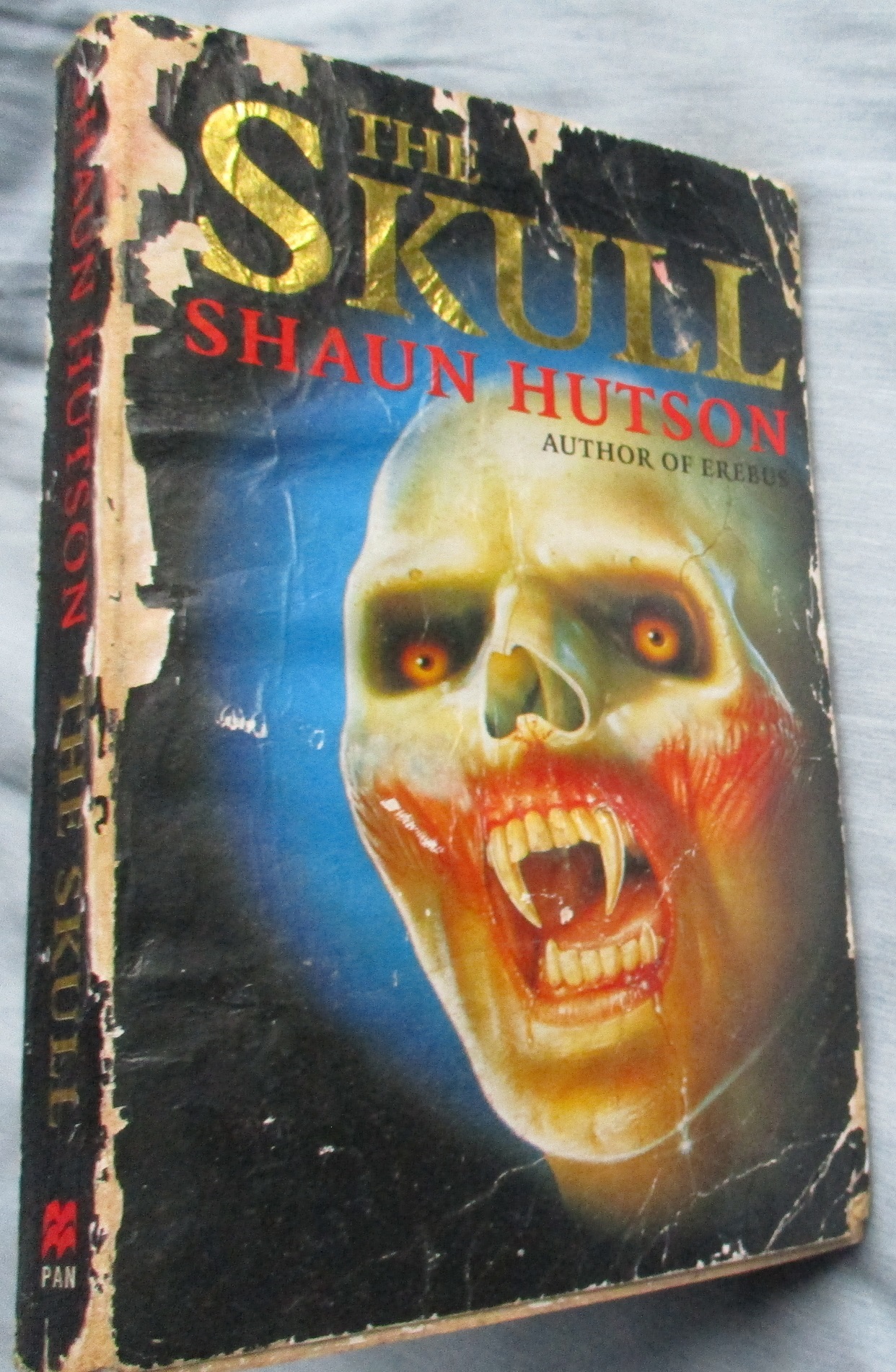
I remember the covers for Slugs, Victims, Assassin, and so have these childhood memories of Hutson's work, without having experienced it until recently. The opportunity to break the habit of a lifetime came, very cheaply, my way recently. My local Tesco has this small section where people donate old books, it isn't staffed, but you're meant to drop some spare change into a charity donation bucket. A copy of his early book 'The Skull' appeared there, and so I picked that up only to realize I didn't have any change on me. Fortunately there wasn't anyone around, so I just simulated dropping money into the charity bucket. The next time I was there though I did purposely being along some spare change with me and dropped 24p in there, in very small change to make it look like I'm a better and more charitable person than I actually am.

This copy of The Skull has its fair to say, had a very hard life. It's in the kind of condition that would give book collecting aficionados nightmares. Every time I open it up part of the cover flakes off, the pages have this warped thickness suggesting it has been exposed to water, parts of it even have these muddy smears so possibly it may have been buried in the ground at some point, mirroring the plot of the book itself.


Despite practically needing to open its pages with a tire iron, The Skull was worth every one of the twenty four pence that I eventually paid for it. Looking around for what people had to say about The Skull online, I kept coming across references to this other early book of his called Chainsaw Terror. That sounded like music to my ears, especially when I learned it tackled two of my favourite subjects...Soho and women being violently killed with power tools.

The back-story to Chainsaw Terror is that it began life with Hutson's publisher pitching the idea that he should do a novelisation of The Texas Chainsaw Massacre, only for that to fall by the wayside because the rights owners of The Texas Chainsaw Massacre wanted too much money. I gather there is a still a problem with novelising TCM since neither the original film, nor any of the numbered sequels have ever got tie-in novelisations. It wasn't until the 2003 remake that the TCM franchise got its first book adaptation. I doubt this was an oversight on behalf of the film companies that have owned TCM over the years, Cannon Films and New Line seemed keen to monetize their ownership of the property, so I have the feeling that someone connected with the original movie either wanted too much or just wasn't willing to play ball. There was a similar situation with the Death Wish sequels, where the author of the original novel Brian Garfield hated the movie adaptation and the direction the sequels went in, and was able to nix plans to novelise the movie sequels. To this day there hasn't been a novelisation of the original TCM, in spite of the current trend for novelising movies that never got a novelisation back in their day. Blood on Satan's Claw recently got a novelisation, as did Night of the Demon and Cruel Jaws, even Shaun Hutson himself has gotten in on the act by writing novelisations of two Hammer films...X the Unknown and Twins of Evil. For a project that began life as a TCM novelisation, there aren’t many traces of that remaining in Chainsaw Terror. Only one scene, where a man is clubbed with a hammer, spasms on the floor, then is dragged away to be cut up with a chainsaw, gives an insight into what a Shaun Hutson version of the Texas Chainsaw Massacre would look like. Instead Hutson, never one to be accused of good taste, appears to have been inspired by the true story of Dennis Nilsen, the gay serial killer who murdered several men and kept their bodies around for sex and company. In order to make this subject matter more palatable for an 1980s readership, the serial killer in Chainsaw Terror, Edward Briggs, is however straight, 'cause that makes him killing people with a chainsaw and making out with a several head that little bit more socially acceptable.

Hutson's version of a chainsaw massacre begins in 1978 when Ralph Briggs, a hardworking carpenter who shares his Kilburn home with his wife and two children, returns home to find his wife intends to leave him for another man. Ralph doesn't take this well, and responds by beating her up, murdering her with broken glass then using the murder weapon to slit his own throat. Setting out his stall early on, Hutson spares no detail when it comes to gushing gore or undignified details 'as blackness finally swept over him, his sphincter muscle failed'. Fast forward a few years to 1983 and surviving Briggs siblings Edward and Maureen are still living at their parents' house and are disturbingly re-creating the parent roles. Especially Edward, who is very much his father's son, having inherited his father's carpentry business and developed a jealous streak when it comes to Maureen. Despite regularly getting hit on by nympho housewives in his career as an odd job man 'he felt uncomfortable in the company of women' and bores holes in their walls, symbolizing his sexual frustration. Edward only has eyes for Maureen, and likes to jerk off while watching her through a peephole or molesting her in her sleep. History threatens to repeat itself when Maureen announces her intension to leave him for another man, and Edward decides that rather than allowing her to leave in peace, he'd rather she stayed in pieces.

When not making out with her severed head and calling her a whore, Edward rationales that he too should be allowed to go out and make new friends. So starts making pilgrimages to Soho, where he picks up prostitutes, then takes them home to meet his sister, and a variety of power tools.

As a kid I tended to look towards film and video as where the wild and outrageous innovations where being made, and regarded books as a far more respectable and staid medium. Well, the likes of Chopper, Bamboo Guerrillas, Eat Them Alive and now Chainsaw Terror sure have kicked that kind of thinking out of me. Respectable and staid are never words that will be synonymous with Chainsaw Terror. Eat them Alive is said to be a favourite of Hutson's, which makes perfect sense. Whereas with Eat them Alive though, it may have been that Pierce Nace's lack of experience in the horror genre may have led her to think that all horror books and movies were just wall to wall bloodshed and sadism, and therefore Eat Them Alive was a work of accidental extremism, there is nothing accidental about that extremism of Chainsaw Terror. This wasn't a book that was intended to go quietly into the night, this was 1984, the height of the video nasty panic, and Chainsaw Terror was blatantly designed to wind-up the tabloids, get confiscated by parents and teachers, to cause outrage and get arrested. The extent that it did get in trouble is where myth and reality have gotten a little blurred. For years the story that was trotted out about Chainsaw Terror was that it completely banned, and eventually re-released in a heavily cut version that removed all of the gore. In recent times a clearer picture of what happened has began to emerged. It appears that Chainsaw Terror fell foul of a leading book distributor, Bookwise, who refused to carry it, purely because it had the world Chainsaw in the title. This being around the time that the availability of The Texas Chainsaw Massacre on videotape was causing a stink, and a few years away from Fred Olen Ray's Hollywood Chainsaw Hookers having to forgo the 'C' word for its UK video release. The Bookwise ban effectively killed Hutson's plans for two further Chainsaw related books called Chainsaw Slaughter and Chainsaw Bloodbath, and lead to his publisher re-releasing it under the less controversial title 'Come the Night'. Another urban myth that has sprung up over this book is that the Come The Night edition is heavily cut, which has made Chainsaw Terror the preferred, and more expensive edition to seek out. In a twist in the tale, avid book collectors who have copies of both Chainsaw Terror and Come the Night have since compared the two and found that apart from the title, there are no differences between them, everything that is in Chainsaw Terror is in Come the Night. Rather than devalue Chainsaw Terror, copies of which are known to fetch around £300, this has actually increased the prices of the two editions of Come the Night. Both the 1985 reprint, and a 1999 edition which was part of a 'three books for the price of one' release that triple-billed it with two other Hutson books that had originally been published pseudonymously.


I'm guessing that Hutson used a pseudonym 'Nick Blake' on Chainsaw Terror because it started life as a commission. Still, while I can understand him writing war and sci-fi novels under fake names, on account of those genres not being what his name is synonymous with, Chainsaw Terror has Shaun Hutson written all over it, and entirely fits in with the nature of the books he used his real name on. If anything Chainsaw Terror is exactly how I'd imagined his books would be like over the years, far more so than The Skull which has always been attributed to him.

Persistent rumours have it that this book was pre-censored by the publisher and around 20 to 25 pages were removed prior to it being  released in 1984. There appears to be evidence of this in the scene where Edward Briggs is about to drive a power drill through the eye of a Soho prostitute, only for the writing to skip over the gore and cut to her dead. Which is uncharacteristic for Chainsaw Terror, this isn't a book to look away from the unpleasant side of life. There has also been speculation that the scene where Edward comes close to killing the two kids, only for their mother to come home and thwart his plans by tripping over the wire of his drill, may have originally been a bit longer and possibly Edward got a second wind. This I am on the fence about, that whole scene is set up for you to expect the worst, only to surprise you by pulling back, as if Hutson was saying "yeah you really thought I was gonna kill those kids, but I'm not that much of a sick bastard". Maybe I'm crediting Hutson with too much of a conscience there though, for all I know there's 20 extra pages floating around of Edward working those two brats over with a blowtorch and a power drill. The official line is that Hutson's original manuscript is now lost and unless that resurfaces the published edition is now the de facto uncut version. Hutson's book was also published in France as "La Tronconneuse De L'Horreur/The Chainsaw of Horror", but they merely got the same edition that we did in the UK.


There is a tendency to speak of Shaun Hutson in the same breath as Guy N. Smith, even though Hutson has been known to take the piss out of poor Guy over the years. Hutson is rumoured to be the source of the famous joke about Guy N. Smith… that Guy N. Smith was such a good farmer because he spread his own books on his land. Which seems to have amused Smith to the extent that he even included that joke in his own autobiography 'Pipe Dreams'. I'm not sure he author of Chainsaw Terror earned the right to look down on the author of Bamboo Guerrillas, it often feels as if Hutson and Smith were in continuous competition with each other back then over who could write the most scenes featuring inappropriate erections. I haven't done a boner count on Chainsaw Terror Vs Bamboo Guerrillas, but both must rate high on the peter meter. Hutson and Smith were also both big on writing heroes that bore more than a passing resemblance to their creators. Smith had his pipe smoking, aquiline featured, hunting enthusiasts, and in Chainsaw Terror, Hutson's man, Dave Todd is this leather jacket wearing, darts playing, sweary journalist, very much created in Hutson's own image.

Where Smith and Hutson do have a parting of the ways, is that with Smith I get the impression that once he became known as a horror novelist he self-consciously cut himself off from horror literature and cinema for fear of being accused of plagiarizing other people's work. In the 1990s, Smith wrote a guide to writing horror fiction, imaginatively titled 'Writing Horror Fiction', in which he goes into the history of pulp horror and comes across as well versed on people like H.P Lovecraft and Algernon Blackwood, yet gets terribly vague when it came to his own generation of horror writers. Hutson, on the other hand, seemed happy to be influenced by the culture that surrounded him. Reading Chainsaw Terror you can sense you are in the company of someone who has seen Taxi Driver, The Texas Chainsaw Massacre and possibly rented out Pieces, little suspecting that it's director would soon after be taking a chainsaw to Hutson's novel Slugs. There is this Taxi Driver like subplot to Chainsaw Terror about Dave Todd trying to rescue a prostitute called Vicki Powell from her evil pimp, Maltese Danny. I also get the feeling that Hutson may have rented Blow Out, since his hero faces a similar moral dilemma of having to jeopardize the life of the whore that he loves, and have her wired for sound to order to trap the killer. Another film that Chainsaw Terror reminds me of, although it has to be a coincidence as they both came out the same year, is Fear City. Which similarly juggles a serial killer plot with that of a tough guy trying to extract a prostitute from the vice world. I guess Shaun Hutson and Abel Ferrara were singing from the same song sheet in 1984.

Chainsaw Terror is Shaun Hutson trying to do for Soho what the likes of Taxi Driver and Fear City did for the deuce. It's this neon lit, soul sucking, sexual netherworld that Hutson is determined to drag you through. Allot of what he writes, does surprisingly hold up to historical scrutiny. During one of Edward's visits to London's red light district he encounters a porn film called Sex School, which sounds as if it's informed by the John Lindsay blue movies in which adult actresses portrayed schoolgirls in the jailbait fixated plots of Lindsay titles like Jolly Hockey Sticks, Schoolgirl Joyride and Girl Guides' Misfortune, which would still have been floating around Soho in the early 1980s.
At one point Vicki Powell recalls being beaten up by Maltese Danny for turning down two rich Arabs, who wanted her to blow one of them, while the other one held a gun to her genitals. This is in keeping with the real life reputation Arabs had in the London vice world back then for paying well but playing rough. In her autobiography Cosey Fanni Tutti recalls Harrison Marks playing the part of reluctant pimp by mentioning that if she wanted to earn a grand there were some rich Arabs in town, but then laid it on strong that they were into the sexually severe...lots of anal... ultimately leading her to the decision that the fucking she'd get wasn't worth the fucking she'd get.

The knee jerk reaction to the Arab anecdote, and making the pimp Maltese, is to wonder if Hutson is being a bit racist here, but once again historical accuracy appears to be on his side. According to an authoritative 1960 book on London vice called The Shame of a City, the majority of the Soho pimps back then were from places like Malta and Trinidad. This isn't reflected in movies from that time like Beat Girl and Passport to Shame, where pimpish characters tended to be played by white actors like Christopher Lee and Herbert Lom. Even in a more recent film like Last Night in Soho, you have an evil white pimp played by Matt Smith. The irony is that both then and now, black or darker skinned actors are losing out on roles that they are historically entitled to play. Back then because of a casting preference for white actors, and now because of a tendency to avoid casting black actors in negative roles.

Something else that Hutson hits the nail on the head about is the foul stench of severed body parts, trust one who knows. At the risk of going off topic, all good sense suggests I need to explain just how I know what severed limbs smell like. A few months ago, myself and a friend were walking around a country park near where I live, and we were hit by this vile, utterly repugnant smell which we dismissed at the time as stagnant water or fly tipping. A day later, the whole area was cordoned off and crime scene investigation vans were everywhere...and it turned out that they had discovered a severed arm, then later when they sent frogmen into the lake, half of a human head. Then another country park was closed down, after limbs were found there, then a further country park got closed down because they found the torso. Two men have been charged with the killing, rumour is that they worked in the meat trade and that is how they managed to dismember the body and the sight of them hauling bags of meat around didn't automatically arouse suspicion. Had those two not been arrested and charged, I might have had second thoughts about commenting on this book. Chainsaw Terror isn't the sort of book you want to admit to reading when severed limbs start showing up in your neck of the woods.

For all the inherent Britishness of Chainsaw Terror, I suspect the only small window of opportunity for a movie version to have been made would have been in Category III
era Hong Kong, its cheerful bad taste would have snuggly fit in with The Untold Story and The Ebola Syndrome. When we handed Hong Kong back to China, we also threw away the chance to see Anthony Wong as Edward Briggs. The nearest visualization we're likely to see of Chainsaw Terror is the mock trailer for Garth Marenghi's Bitch Killer. Which comes from the Garth Marenghi’s Darkplace spin-off series 'Man to Man with Dean Learner', in an episode about an ill fated actor whose career was destroyed by appearing in a movie version of a Garth Marenghi book about a chainsaw maniac. "the dirtiest, nastiest, sexiest film you'll see all year". I would wager that the person who came up with that trailer is also a person who has exposed themselves to Chainsaw Terror at some point. The Bitch Killer trailer even imitates the white on red lettering used in the trailer for Pete Walker's Frightmare. So, if you're not just paying homage to Pete Walker films, but the look of a trailer to a Pete Walker film, you are clearly someone with advanced, master level knowledge of British sleaze, and are probably the person who has paid £300 for a copy of Chainsaw Terror.


Although there isn't the safety net of 'this could never happen in real life' that you have with Slugs or The Skull, I think Chainsaw Terror still captures the 'fun' side of 1980s gore that you get with The Evil Dead, Re-Animator and The Deadly Spawn. Yes, they are gross and revolting but it's a thrill ride that isn't going to leave you mentally scared or weighing heavily on your conscience. At the same time, Chainsaw Terror does anticipate the morbid, depressing direction that the gore film was heading in with the likes of Nekromantik, Aftermath, Deadbeat at Dawn, A Gun for Jennifer, where it felt like these films were made by angry, nihilistic people and gore stopped being fun for a while. Despite walking a tightrope between the two, for my money Chainsaw Terror always manages to stay on the entertaining side of gratuitous violence.

No names from me, but I had a bad experience with a recent self-published extreme horror novel, that by rights should have been the heir apparent to Chainsaw Terror. So, why did I get on with Chainsaw Terror and not this newer book about a chainsaw maniac? I suppose it was because the newer book gave the strong vibe that its author really needed to get laid, rather than spending all day writing about naked female bodies being mashed up, and incriminated himself as a suspect incel in his book. Whereas Chainsaw Terror for all its excess and Hutson's insensitive rock n’ roll swagger, still has the faint ticking of a moral compass. Bad people get what's coming to them, there is a redemptive story arc for Vicki Powell, and an everyman hero you can get behind in Dave Todd. Danny the pimp is simplistically depicted as a one dimensional scumbag and there is no attempt to humanize him or get into his head that you'd find with books by Iceberg Slim or Donald Goines. Chainsaw Terror does spend allot of time with Edward Briggs, but even there you never sense that Hutson regards Edward as anything other than a freak and a weirdo. There's a line in the sand drawn between author and chainsaw maniac here that you probably wouldn't get with a writer of the incel persuasion.

Chainsaw Terror leaves the impression that once the cheque for writing it cleared, Hutson was down the pub or going to a Liverpool FC match, rather than buying a new chainsaw and slaughtering innocents. It should be mentioned that the copy I read of Chainsaw Terror is a library copy, which was evidently taken out of a local library for just about every week of 1986 and into 1987. A reminder of just how mainstream and popular, horror sleaze was with the British public, back in the wonderful, morally bankrupt decade that was the 1980s. Apart from with the one library user who felt compelled to write in pen, and in block capitals 'TRASH' on one of the closing pages of the book. Though I suspect that Hutson is of that rare breed of author who would take that kind of incensed defacing as a complement.