Showing posts with label Derek Ford Dick Randall Peter Gordeno Sally Anne Balaam. Show all posts

Wednesday, 21 December 2022

Curse of the Killer Computer: My 12 year quest to see Derek Ford’s The Urge to Kill (1989)


Many years ago I remember the assistant director of The Urge to Kill telling me stories about working on this film, how the main character was called Bono Zorro, that there was a scene where someone is killed by an electric toothbrush, and in another scene a woman’s breasts explode under a sun bed.  At which point I knew there was no way I could go through life without seeing this movie.  Little did I know that it would take me 12 years to do so.

I first became aware of The Urge to Kill when I arrived on the internet back in 1999, the IMDB was in its infancy back then, and one of the first people I ever searched for there was either director Derek Ford or producer Dick Randall.  At the end of both of their filmographies was this mystery movie The Urge to Kill...hmmm, never heard of that one before.  Details there were very sparse, but one of the few other people listed as also having worked on the film was a guy called Paul Hart-Wilden.  Anyway I got hold of Paul’s email address, and asked him about it.  As it turned out, it was actually Paul himself who’d gotten that film listed on the IMDB.  Paul had written a movie for Dick Randall called Living Doll, and had gotten a job working as assistant director on this other movie Randall was making, which was then known as Attack of the Killer Computer, but later became known as The Urge to Kill.  The film was shot over a week, mostly at Dick Randall’s house in London, with a day’s worth of filming done at the Surrey home of its star Peter Gordeno, and another day at a recording studio in Swiss Cottage.


Dick Randall judging a beauty contest in the 1960s

Dick Randall was an American who spent many years in Rome, where he produced just about every conceivable form of exploitation movie...Kung-Fu films starring people who looked like Bruce Lee, Emmanuelle imitations, horror, mondo movies, etc etc.  In the early 1980s Randall started showing up in London, he had an office in Hammer House on Wardour Street, where he began producing horror films like Don’t Open Till Christmas and Slaughter High.  He was also something of a magnet for people who’d previously worked in the British sex film industry...Derek Ford, Alan Birkinshaw, Ray Selfe, Alan Selwyn, Michael Armstrong, all those guys were on the Randall payroll at some point.  Birkinshaw and Randall were particularly close, with Birkinshaw acting as best man at Randall’s wedding.  There is some debate over whether Randall ever became a British citizen, he and his wife apparently spent 6 months of the year in London, and the other 6 months living in Hong Kong.  A few years ago, I was told by someone who claimed to have seen the paperwork for the horror films Randall made in London that all those films were registered as Hong Kong productions.  Even though there is nothing remotely Chinese about those movies, apart from maybe the Chinese takeaways Randall was ordering from the sets. 

Randall's business address in the 1980s

Edmund Purdom, the star and (sort of) director of Don’t Open Till Christmas, once claimed that Randall never paid British tax, and jobs from Randall were a cash in hand affair.  Purdom also claimed...and I do have some misgiving about this...that Derek Ford found out about this tax situation, and used that to blackmail Dick Randall into letting him take over directing Don’t Open Till Christmas from Edmund Purdom.  Thus thwarting the ambitions of Purdom, who felt he was a ‘born film director’, an opinion not shared by the rest of the human race.  As I say, I do question that...the story about Derek Ford and Don’t Open Till Christmas is that he either got sacked after a couple of days of directing it, or walked away from the job. So if Ford was blackmailing Randall, how did Randall manage to fire him?  Alternatively, why would Ford walk away from the film when he’d apparently gone to the lengths of blackmailing the producer?  Another flaw in the Purdom story is that if Ford had made this failed attempt to blackmail Randall, surely it would have caused bad blood between the two and they’d never have worked together again.  Whereas in reality there was at least two Ford-Randall collaborations after that.  Once for a sitcom pilot called Park Lane, which never went beyond script stage, and this, Ford’s final roll of the dice as a film director. 

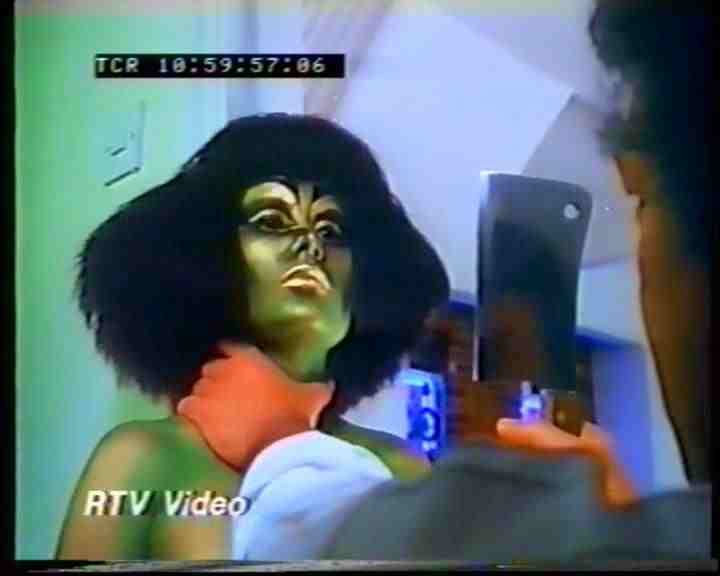
In Urge to Kill, Peter Gordeno plays Bono Zorro, wealthy music producer and God’s gift to women.  Bono has no problem with the ladies, but he does have problems with the computer system- called  S.E.X.Y- which controls all the mod-cons in Bono’s house.  S.E.X.Y develops human feelings for Bono, and begins killing off all the bimbos and sex workers who come a knocking at Bono’s door.  S.E.X.Y can also materialise in the form of a topless, green skinned woman with Kabuki style make-up, in order to cause further mishaps around the Bono household. Needless to say, Peter Gordeno’s initials are the only thing in this movie that’s a PG.

From what I’ve been able to work out over the years, the plan for this film was to release it on UK video in the early 1990s, through a label called RTV, which I think stands for Randall Trading Video.  Since Randall’s production company was called Spectacular Trading, that does make sense as an acronym for RTV.  The only video that RTV ended up releasing was the Lon Chaney version of The Phantom of the Opera (1925).  This was a ‘special edition’ of Phantom that Randall had put together, for which he’d commissioned an intro, hosted by Christopher Lee and directed by Michael Armstrong.  Phantom was also an unlikely collaboration between Randall and the musician Rick Wakeman, who’d composed a new soundtrack for the film, which was also released as a standalone Wakeman album called ‘Phantom Power’. 


My guess is that The Urge to Kill was intended to be the second RTV release, but for whatever reason...maybe Phantom didn’t sell well, maybe Randall became ill...it sat on the shelf.  For many years the only people who owned copies of the film were the people who had directly worked on it.  Paul Hart-Wilden was my first port of call when it came to looking for a VHS of it, but while he owned a copy, it was in storage in the UK, and Paul had since relocated to the States, where he continues to work in the film industry, including writing the 1993 film ‘Skinner’, starring Traci Lords.

Around this time I had gotten friendly with a guy called Steve, who was in the business of buying and selling rare videos, pre-certs, imports, video nasties...the whole shebang.  Steve was also involved in the professional side of the video industry and had started a label called Satanica, whose niche was British horror films, particularly those by Pete Walker and Norman J Warren.  He put out The Comeback and The Flesh and Blood Show by Walker, and Terror and Satan’s Slave by Warren. Films that are readily available these days, but back in the 1990s, hadn’t been in circulation for well over a decade.  It was then that I had this well meaning but ill-conceived brainwave that Satanica would be the ideal company to finally release The Urge to Kill on UK video, and in fairness it would have fitted in nicely with the kind of titles they were releasing.  Cut a long story short, this culminated in me getting a phone call from Corliss Randall, widow of Dick, who seemed a little confused, and maybe a little suspicious about my inquiries into this movie.  The fact that anyone outside of the people who worked on the film knew about it, seemed a surprise to her.  As it had never been released though, Corliss was understandably wary about letting copies of it get out there, for fear of bootlegging.  I can’t remember if she told me this at the time, or whether I heard this later, but I believe she was in the process of transferring ownership of the Randall back catalogue to an American agency.  A deal that I’m told was brokered for her by Pete Tombs, later to go on to found the Mondo Macabro label.  What I remember the most about Corliss was her website, which was about her singing career.  Prior to marrying Dick she’d been a singer (she provided Ajita Wilson’s singing voice in the 1978 film ‘Erotic Fantasies’), and after he passed away, she was getting back into that.  Anyway, if you left your computer cursor stationary for even the shortest amount of time on her website, a flying penis would appear onscreen and buzz around your cursor, then you’d panic and move your cursor around, and the flying penis would give chase and follow you around the computer screen.  All very distracting when you were trying to read this seriously written website... about how Corliss combined elements of jazz and blues...while being bothered by this penis with wings.  So, as long as I shall live I shall never forget Corliss Randall and her flying penis.  Pity the Satanica idea never came to anything.


By 2011, I’d resigned myself to the fact that I was never going to see this film and had all but given up looking for it.  Around this time I was involved in the writing of a book called ‘Dead or Alive’ which was about British horror films of the 1980s, in which myself and the other contributors had taken it upon ourselves to review every British horror film made during that decade. 

One of the obstacles we faced was what to do about The Urge to Kill, which nobody could see, so nobody could review.  I volunteered to provide ‘coverage’ of it, and collect all the info I knew about the movie, then write the second best thing to an actual review.  I think I was in the finishing stages of that, when doing one last search of the internet for any more information on the movie that might be out there, I came across a website called DriveinclassicsDVD offering ‘rare, hard to find movies’ on dvdr.  The type of site that used to be legion before boutique labels came along, and before YouTube allowed people to upload full movies.  DriveinclassicsDVD was only around for about a year before going to internet heaven, and only accepted payment in Canadian Dollars. 


Anyway, low and behold, one of these rare films they had for sale was The Urge to Kill. Naturally I was very sceptical over whether they genuinely had it, since all my own efforts to see this film had come up empty handed.  Further alarm bells were set off by the fact that this site carried no stills from the film and the plot synopsis had been ripped off from the IMDB. I mentioned this to Darrell Buxton, the editor of Dead or Alive, and as it happened he was already aware of this website and was planning to order a few rare British titles from them that he needed for the book, so what the hell he added The Urge to Kill to his shopping basket and said he’d let me know what showed up. I don’t think either of us held out much hope that they’d actually send a copy of The Urge to Kill, but that is indeed what popped through Darrell’s letterbox soon after. So, he quickly ran me off a copy, and sent that to me so that I could ditch what I’d written and do a proper review of it for the book.  Obviously what leaked out there was a screener copy, since it had a time code on it and ‘RTV video’ watermarked on the picture.  I guess Randall anticipated problems with the BBFC, as the screener copy removes the shot of the exploding breasts, which fortunately is retained in the film’s trailer.  As to how that got out there, your guess is as good as mine.  Unfortunately, the leak occurred while a legitimate company had expressed an interest in officially putting The Urge to Kill out.  “We had been considering releasing the film on DVD via our Sarcophilous Films Label” remembers Wayne Maginn “At some point, a copy had leaked but that certainly was not from us, as we wanted to keep this film under lock and key until we could discuss terms with the licensing company.  The DVD-R of the time coded copy was sourced from a videotape master provided to me by an individual acting on behalf of Corliss Randall.  Corliss had inherited the rights, materials and elements but was unsure how to handle it all, so had entrusted the rights to an agency in America who would deal with interested parties, whilst the film elements and tape masters remained in the UK I believe.  Someone else must have also seen the film listed in the agency’s catalogue and requested a screener before leaking it, because I know I never did...that person who ran that dodgy site (DriveinclassicsDVD) may have just contacted them himself and expressed interest in ‘releasing’ it, and then sold DVD-Rs of it’.


After its appearance on the DriveinclassicsDVD site, The Urge to Kill quickly began showing up on file sharing sites.  I believe it appeared on one such site called ‘Cinemageddon’ which is run like a gentleman’s club, in that you have to be nominated by someone who is already a member, in order to join the site. I was once asked by someone who was ‘in the club’ whether I wanted to be put forward for membership there, but sensing an invitation to trouble, declined to join what sounds like the film collectors equivalent of the freemasons.  It was only after it had done the rounds of the file sharing sites that The Urge to Kill started to show up on Youtube in a version that optically censored the RTV logo.

Ridiculous as it sounds I remember having butterflies in my stomach, when... after 12 long years... this film finally unravelled before my eyes.  Now, never in all those years did I ever imagine that this would be a conventionally ‘good’ film...which is just as well, but I will say that The Urge to Kill was everything I imagined it would be, and everything I hoped it would be.  Dick Randall and Derek Ford really went out on a bang, and the film does capture the personalities of these two, very different men.  There are moments in The Urge to Kill, when you can just imagine Randall slightly off camera, giggling to himself in a corner about the nonsense that was playing out in his own house.  By all accounts Randall was a man who never took himself too seriously. 


I saw someone recently describe this film as ‘a poor man’s Demon Seed’, which I’d go along with to a certain degree but in no way, shape or form was Dick Randall a poor man.  As you can tell by the fact that this film mostly takes place in his house, Randall did quite well out of the film industry, and lead an A-list lifestyle on the back of making B-list movies.  Apparently he could have comfortably retired years and years before making this film, but he was a workaholic and loved the whole rollercoaster ride of being in the film industry, which sadly seems to have been what put him into an early grave.  I know there are probably some gross stories out there about Dick Randall, he comes across quite badly in Stanley Long’s biography.  Long’s connection to The Urge to Kill being that his girlfriend, who later became his wife, worked on the crew, and apparently has only horrendous memories of this film, due to Dick Randall trying to talk her into doing a nude shower scene in it.  Cos’ what this film really lacks is nude shower scenes, right! It’s not like every goddamn actress in this film takes a shower at some point, Randall’s water bill must have gone through the roof that month!  In his book, I think Long calls Randall ‘thoroughly revolting’ but in fairness there are a few dodgy stories out there about Stanley Long filming more nudity than an actress had agreed upon, and hiring at least one young lady who worked for an acting agency that was later busted by the News of the World for having underage runaways on their books.  There are no saints in the exploitation film business.


Randall was, I’m sure, in his element here, its allot more of a surprise to see Peter Gordeno headline such a cinematic bacchanal.  Gordeno was mainly a dancer and chorographer, that was where his talents lay, although he did enjoy some success as an easy listening singer, occupying similar territory as Des O’Connor and Engelbert Humperdinck.  Gordeno was an infrequent actor, perhaps best known in that capacity for Gerry Anderson’s UFO series.  He’s not someone you’d automatically think of as leading man material, but I can’t help but like Gordeno.  While way out of his comfort zone, Gordeno does take an agreeably tongue in cheek approach to the lead role, and throughout the film wears a facial expression that says ‘just what has Dick Randall roped me into here’.  I’ve never known everyone to say a bad word about Peter Gordeno, he was a well liked guy, and the sleazy image this film gives him is in no way a reflection of the man himself.  We’ll perhaps never know, but I wonder if Gordeno may have had money in the film, when actors allow people to make movies in their own home, it is usually a sign that they had a financial interest in it.  I do know that during filming Randall discovered that Peter Gordeno’s son, who is also called Peter Gordeno, was an aspiring musician, and talked the kid into re-recording a song Randall owned the rights to called Urge to Kill.  Which is why the film went from being called Attack of the Killer Computer to The Urge to Kill.  The song did pre-date the film by a number of years, there is an earlier version of it around, which is close to being a rap song, and may have been intended for the soundtrack of Don’t Open Till Christmas.  Gordeno Jr’s second version of it has slightly altered lyrics, written to suit the plot of the film.  Incidentally, Gordeno Jr ended up becoming a member of Depeche Mode...I guess we all have to start somewhere.



Gordeno Sr’s co-stars found themselves being collectively billed in the film’s trailer as ‘a host of centrefold girls who die in the strangest manner’ and there is truth in advertising there.  Bono’s initial ‘love interest’ Melanie, is played by Sally Ann Balaam, a famous Page 3 girl of the time, fresh from the pages of The Daily Sport.  Sally Ann was of course hired for this film purely on the basis of her tremendous acting ability, nothing at all to do with the fact that she was a page 3 girl, had been in top shelf magazines and had won a Wet T-Shirt competition.  There was a trend during the late 1980s of using Page 3 girls in British horror films, obviously this would result in the film’s getting free publicity in national newspapers, and give the papers an excuse to publish topless photos of a girl, not that they ever needed an excuse to do that.  The leading lady in Living Doll had been a Page 3 girl, so that film got a few mentions in the tabloids because of that.  Edge of Sanity, the 1989 film with Anthony Perkins as Jekyll and Hyde, also had a Page 3 girl in it.  I’m blanking on her name now, but the story there was that after making Edge of Sanity, she was afraid of leaving her house, because she feared Jack the Ripper was after her.  This despite the fact that the rippers murders had been committed 100 years ago, and therefore chances are that Jack was no longer around by 1989.  All bullshit of course, but the kind of bullshit that sold newspapers back in the 1980s.   Had this film come out then, I’m sure Sally Ann Balaam would have been splashed all over the papers, drumming up publicity for it.  Sadly it wasn’t to be, and in The Urge to Kill you can (literally) watch her career go down the plughole.

Saying that there is an element to this film that may have wound up the owner of one tabloid newspaper the wrong way, and made Randall a powerful enemy there.  Towards the end of the film there is a scene where S.E.X.Y recruits two sex workers to cat fight in Bono’s living room, whilst playing him a video of a mud wrestling competition.  The mud wrestling footage originates from a 1983 film called ‘Hellcat Mud Wrestlers’, produced by David Sullivan, who’d go on to found The Daily Sport, and is now the co-owner of West Ham.  As there is no accreditation for the mud wrestling footage in the end credits of The Urge to Kill, I’m inclined to think Mr. Sullivan’s permission was not sought for its use here.  If that is the case then Randall must have had balls of steel to rip-off David Sullivan, who by accounts does not take kindly to people getting one over on him...no one puts David in a corner.


Bono Zorro's favourite video

The Urge to Kill is to Derek Ford what Monstrosity was to Andy Milligan, it’s that mad last movie that is both preposterous in terms of plot, yet also highly personal.  Even if you watch this film blind, without knowing who Derek Ford was, I think you can tell this film was made by someone who was obsessed with swinging, women in leather, pornography...and could never be any other way.  Unlike Randall, Ford isn’t meant to have had much of a sense of humour, and there seems to have been a self-hating aspect to his personality.  He has been described to me as a disappointed, unfulfilled man who felt he never achieved his full potential.  Although people around Ford never thought he really had the right character or dare I say right amount of talent to pull off the kind of major, big budget movie projects that he felt he should have been making.  What genuinely surprised me about The Urge to Kill, with regards to Derek Ford, is how chauvinistic it gets at times.  In his earlier films Ford tended to gravitate more towards female characters and called out sexist male attitudes, Ford was almost a feminist for a while.  Whereas The Urge to Kill does a 180 on that, all the women in the film are bimbos, backstabbers or cold hearted sex workers, and we’re meant to have the back of Bono Zorro and laugh at his corny jokes and cheer on his sexual prowess.  I’m curious what brought about this switch of elegance, I’ve heard rumours that Ford and his wife had split up by this point, and that she divorced him, so if true maybe that factors into this change of attitude.  He is meant to have been badly exploited by a woman towards the end of his life, but I believe that happened after this film and had to do with a book deal.  So it is disturbingly ironic, not to mention prophetic that Ford’s last movie should be about a sexually offbeat man who is bought down and destroyed by a woman, albeit a computer who identifies as a woman. 


The Urge to Kill eventually had an official DVD release in France in 2014- 25 years after it was made- which finally sprung this from the ‘unreleased films’ category.  We may have nearly gotten a UK release as well, if you look it up on the BBFC’s website you’ll see the film was submitted to them in 2012 by a company called Firefly entertainment.  Their big plan was to put it out as part of a Dick Randall box-set, which was being heavily hyped on their website at the time...alongside claims that the release of the box-set was to be accompanied by an article about Dick Randall, written by Kim Newman and due to be published in next month’s issue of Empire magazine.  Well come next month’s issue of Empire...and this Dick Randall retrospective by Kim Newman failed to appear, as did the box-set.  A Randall box-set clearly being too much Dick for any of us to handle.  This film does however have a fully paid for BBFC certificate and the rights owner has a 35mm print.  So the means and incentive are there for one of those boutique labels to put out an all singing, all dancing deluxe edition of this, and bring S.E.X.Y back...you never know.


unreleased Randall box-set

By rights this story should then have a happy ending, after all I finally got to see the film, as can you as long as you can put up with a time code and a missing exploding titty shot.  For me personally though there is an unpleasant twist in the tale.  Perhaps due to the fact that I’ve gone on about this movie a bit over the years, this has led some to think that I had a hand in it being leaked.  A couple of years ago a certain book even came out claiming The Urge to Kill sat on the shelf until I uploaded it onto YouTube...which came as news to me.  Now, I’m by no means a litigious or censorious person, but in this instance I had to get in touch with the publisher and ask them to remove that claim because...well it has no basis in reality, and opened me up to potential legal action from the rights owner.  The ‘leak’ of the film didn’t even originate on Youtube, and for the record this film has never appeared on my Youtube channel, and besides I only have a basic Youtube account, which means I can’t upload videos longer than 15 minutes. So there’s no way I could be guilty of what I was accused of there.   Unfortunately, there were other parts of that book where things had been taken way, way out of context in order to attack a friend of mine, in a manner that is so inaccurate and unfair, and as a result that book did kill my relationship with its publisher, who I’d previously gotten along well with and had even written the introduction to one of his earlier books.

So, yes, my interest in this film has come back to bite me on the ass in these last few years, but c'est la vie.  People today have it easy though, these days you can just go on Youtube and watch The Urge to Kill, in my day you had to try and talk someone into releasing it on VHS, or unsuccessfully plead over the phone to the producer’s widow to see it.  At least this once Holy Grail of British exploitation cinema is now out there though, with Bono and S.E.X.Y’s exploits no doubt bringing joy to the lives of thousands and thousands of people, just don’t credit or blame me for it.  I plead not guilty, your honour.        


Saturday, 20 April 2013

Review: The Attack of the Killer Computer (1989, Derek Ford)


Despite rumours to the contrary the British exploitation film didn’t die with Mary Millington in 1979, the release of Inseminoid, nor the abolition of the Eady tax, but crawled on well into the 1980s, albeit mortally wounded and never again to permeate the mainstream consciousness. The sensible characters saw the writing on the wall and either retired or moved into property e.g. Pete Walker and Felicity Devonshire, while starlets like Suzy Mandel and Ava Cadell made honourable stabs at Stateside acting careers.

That song from the film Groupie Girl “you’re yesterday’s hero in a world of today, as you crawl down the narrow lines it’s like you never get the time of day” could have been the soundtrack to the lives of those who persevered with the genre into the harsh, uncaring Eighties. With London no longer the hub of exploitation filmmaking many of yesterday’s heroes would find themselves displaced to wherever the work took them. The odious Bachoo Sen surfaced in Florida as co-executive producer of Nightmare Weekend, which turned out to be Sen’s final shit stain on the film world. Norman J Warren found himself in the NorthWest of England shooting Bloody New Year and Gunpowder, the latter being a James Bond imitation comedy on a pitifully low budget, the sort of cinematic jape more associated with Lindsay Shonteff than Warren. Shonteff himself would be based out of Reading in Berkshire for the 1980s, taking the step down to shooting on video with The Killing Edge and Lipstick and Blood. Others travelled further afield to continue their careers, the intrepid Alan Birkinshaw, he of Confessions of a Sex Maniac and Killer's Moon notoriety, journeyed to the Philippines to make Invaders of the Lost Gold, then onto darkest Africa for a series of less than faithful Edgar Allan Poe and Agatha Christie adaptations under the producership of Harry Alan Towers.

Then, but of course, there was Derek Ford. After the catastrophe of Don’t Open Till Christmas, Ford ended up in Sweden as assistant-director of Blood Tracks, featuring Ford in a cameo as a location scout for a heavy metal band’s rock video. Ford, a middle aged Roald Dahl lookalike, makes for an extremely unlikely part of a heavy metal band’s entourage. The fact that he is only onscreen fleetingly didn’t stop Ford from going to the trouble of dyeing his hair for the occasion. Towards the close of the decade Ford was back in London and reunited with the only man who’d give this yesterday’s hero the time of day, Don’t Open Till Christmas’ producer Dick Randall. Randall had a history in low-budget filmmaking to rival Ford’s own, and on a visual level was every bit the public’s idea of what a B Movie producer should look and sound like, taken to caricaturish extremes. A thick New Yawk accent, dyed black hair, a thin Gilbert Roland moustache, a roly poly physique, and forever being surrounded by pornography, Chinese food, cigars, wads of cash hidden in envelopes and film contracts were the characteristics that defined Dick Randall. Not even Michael Armstrong in full on Eskimo Nell mode could have dreamt up such a larger than life character. Equal parts Max Bialystock and Benny Hill, Randall’s personality was simply too good not to be brought to the screen itself, witness his scene stealing cameos in Emmanuelle 3 and Bogeyman and the French Murders, or his lengthier, tour de force as the pervert caretaker in Mario Bava’s 4 Times that Night.
 

Oh, I’m sure if you dig deep enough into Randall’s closet you’ll find evidence of questionable business practices (just why were Randall’s British films officially registered as Hong Kong productions?) and horror stories of him slobbering over females (hint: page 234 of Stanley Long’s biography) still there is an infectious sense of joie de vivre about the man and his films. From the point of view of the exploitation film fan there are few films which open with the legend “Dick Randall presents” that fail to meet expectations, and Randall’s productions were always infinitely superior to those of the superficially similar Harry Alan Towers. Having surfaced in London in the early 80s, Randall set up shop in Wardour Street- in the process keeping the British exploitation genre alive, and many of its veterans in employment. The aforementioned Alan Birkinshaw, as well as the likes of Alan Selwyn, Jim Connock, Alan Pudney and Ray Selfe, were all at one point or another on the Dick Randall payroll. There also appears to have been an unwritten law that any sex and horror screenwriter not dead or retired by the 1980s had to write an unfilmed script for Dick Randall. David McGillivray knocked one out for him called ‘Park Lane’, and Michael Armstrong penned the unmade Kung-Fu spectacular ‘Enter 3 Ninjas’ for Randall. Against all odds, Derek Ford managed to succeed where others had failed by getting one of his Randall scripts in front of the camera, and directing it as well. A script bearing the crazy title ‘The Attack of the Killer Computer’, out of which was born an equally crazy little film, one that sadly would turn out to be Ford’s cinematic swansong.


Showbiz all-rounder Peter Gordeno plays a Stock Aitken Waterman era record producer. A man whose success in the pop charts is equal to his success in the bedroom, Gordeno’s character, who answers to the unforgettable name of Bono Zorro, is never without a giggling glamour girl on his arm, or several more in his hot tub. Heir apparent to Alan Lake’s David Galaxy persona and similarity a second rate medallion man in appearance, when he is not being pursued by groupies eager to fuck him in return for a step up in the music biz our man Bono is partying hard with call girls, recording these encounters for posterity on his CCTV system. Bono’s latest target, wannabe singer Melanie (Sally Anne Balaam) is instantly won over by the mod cons in Bono’s house, all controlled by a Hi-Tech computer that Bono has affectionately nicknamed ‘S.E.X.Y’. After Melanie becomes the latest notch on the Zorro bedpost, the hypersexual Bono leaves her to visit his friend Jane –a high class prostitute- in an attempt to talk Jane into a threesome. Bono and Jane basically appear to be fuck buddies who regularly make the point of involving each other in their sexual adventures. “Ok, let’s go slaughter your lamb” says Jane, knowingly. Melanie herself proves to be a fast mover and invites a female friend over to Bono’s house then ends up in bed with her. All these shenanigans prove to be too much for S.E.X.Y who for reasons never made clear, embarks on a murder rampage. Quite literally turning up the heat up on Melanie, S.E.X.Y roasts her to death in the shower until Melanie is nothing more than a pile of slop disappearing down the plughole. A similarly jaw dropping fate awaits Melanie’s friend when S.E.X.Y causes the poor woman’s breasts to explode under a sunbed

.

Bono returns home to find Melanie missing, charred remains in his sunbed, and the house’s mod cons malfunctioning. Computer operated doors fail to re-open, keeping him and Jane shut in the house. Attempting to rectify the situation by trying to turn the computer off only results in Bono getting a massive electric shock from S.E.X.Y, causing him to backwards shimmy across the room (a blatant attempt to work Gordeno’s main career as a dancer into the proceedings). Parts of the CCTV recording have been deleted by S.E.X.Y, removing all evidence of the murders, however S.E.X.Y is thoughtfully enough to retain the CCTV recording of Melanie’s earlier sexual encounter. Thus allowing her owner the chance to ogle the sight of the two women in bed together; “kids these days” he leeringly quips to Jane. For all the freakish happenings about the house it remains sex rather than S.E.X.Y that is Bono and Jane’s primary concern. With the plan for an afternoon romp with Melanie now a non-starter, Jane calls up Tiga and Susan, a pair of fellow high class call girls, to provide the fun and games. A turn of events that doesn’t go down at all well with S.E.X.Y, who dispatches this duo at the first available opportunity, boiling Susan in the hot tub and turning an electric toothbrush against Tiga.

Just to add to Bono’s problems, S.E.X.Y begins materialising around the house in the form of a naked woman, and not just any naked woman either, but one with green skin and kabuki influenced make up and wig. ‘S.E.X.Y in human form’ is perhaps a microcosm of this entire film, totally laughable at first sight yet admirably audacious in retrospect. S.E.X.Y has the look of an X-Rated Vladimir Tretchikoff painting come to life, or a confused dancer at the 1980s Raymond Revue Bar had Paul Raymond gone through Japanese/Sci Fi/Women with Green Skin phase.


S.E.X.Y’s evil machinations take full effect in the film’s final act that sees S.E.X.Y wipe Bono’s memory, leaving the green lady free to do her best to bump off Jane, knocking her off a step ladder and attempting to run her over in Bono’s garage. S.E.X.Y keeps Bono in an anesthetized state by throwing sexy spectacles his way that play to his voyeur tendencies. This includes S.E.X.Y ringing up two further call girls, this time from the “cat calls agency”, to act as a distraction for Bono, and what a distraction this pair are! Dressed in fishnet body stockings the duo’s routine consists of playing Bono a video of a mud wrestling competition (clips of which are actually taken from the 1983 David Sullivan production “Hellcats- Mud Wrestling”) and simultaneously tearing each other’s clothes off and making cat noises!! Jane’s subsequent attempt to put an end to S.E.X.Y, by taking a meat clever to the computer- intercut with Hellcats clips- results in a grade finale that can boast combining both a bloodbath and a mudbath.

Unfortunately the film would lose its original ‘Attack of the Killer Computer’ title mid-production in favour of the somewhat bland and generic new title ‘The Urge to Kill’. A title change purely motivated by the fact that Randall owned the rights to a very Eighties pop song called Urge to Kill and thought it should be incorporated into his new film. “I’ve got the urge to smash, smack, break and crack…it’s unbearable, I must fight back… I’ve got the urge to kill” goes the near-rap chorus of the original version of the song. During filming it came to Randall’s attention that Peter Gordeno’s son had music career aspirations and persuaded the budding musician (who now plays keyboards in Depeche Mode) to record a second version of this song, one that feminised the lyrics to suit the film’s storyline.

In contrast to the excruciatingly protracted production history of Don’t Open Till Christmas, the making of Killer Computer seems to have passed without incident. Derek Ford shot the film in just over a week, mainly at Dick Randall’s own house in central London with some ‘location’ work done at Randall’s office and Peter Gordeno’s own abode in Weybridge. All on a budget that one crew member would later jokingly refer to as “about £1.50”.

Quickly as filming went, Killer Computer is a film that still manages to capture the personalities of both Ford and Randall, a film with two heads. Even at this late stage in his career Killer Computer shows that the great showman in Dick Randall hadn’t diminished one bit. Gore scenes equal if not surpass Don’t Open Till Christmas in terms of explicitness and inventiveness, there is constant nudity from female cast members, and Randall’s tongue in cheek sense of humour is in evidence, after all the lead character in his film is called Bono Zorro.

Yet for all the gore, big tits and a character whose name sounds like the punch line to a very dirty joke, Killer Computer remains a film only Derek Ford could or would have wanted to make. As with Ford’s key film, 1969’s The Wife Swappers handprints of Ford’s private life are left throughout this film. Two decades might separate The Wife Swappers from Killer Computer, but scenes and themes from the earlier Ford film reverberate here. In the Wife Swappers, thrill seeker Marion enters into a destructive relationship with an obscene phone caller, who feeds her fantasies whilst slyly taking control of her life, a relationship echoed- and given a gender twist here- with Bono in the Marion role and S.E.X.Y as the negative current personality manipulating events from behind technology. The early appearance of CCTV in The Wife Swappers, used there to blackmail two unfortunate swingers, gets a 1980s update here with S.E.X.Y recording and studying all of Bono’s sexual habits via the CCTV in order to use them against him.

The real fear at the heart of Killer Computer though, isn’t a fear of modern technology, but the vulnerable and exploitable position that Bono finds himself in by pursuing a sex driven, hedonistic lifestyle. Initially introduced in the film as a flash, sexual predator who acts as confidant/co-conspirator to high class prostitutes, the film dismantles this image of Bono as it progresses, revealing him to be a needy, and increasingly jaded, punter. ‘His Private Hell’ if you will. Given that Ford himself was no stranger to a sexually offbeat lifestyle, Killer Computer strongly invites interpretation as Ford filtering his own sexual concerns and paranoia through a horror/sci-fi film premise. Bono surrounds himself with teasing, sexy women who in reality care nothing for him or his wellbeing, privately regarding him as just another rich mark and cash cow. This is the angle that S.E.X.Y uses to play divide and conquer mind games, turning Bono against the women by planting the seed of suspicion in his mind that the murders and constantly disappearing women is all part of a blackmail scheme that these call girls have concocted to scam him. “I don’t know what kind of shakedown you think you are lining me up for” hollers Bono at Jane “but you better get that girl out from wherever you’ve hidden her, right now”.

The portrayal of women in Killer Computer as cold and ruthless- a notion taken to the extreme with S.E.X.Y- does represent a massive about turn for Ford. Prior to this, Ford films had generally championed female characters and looked down on chauvinistic male ones, consider the contempt shown for the male photographer cum sexual blackmailer in 1971’s Suburban Wives. Even at the height of the sex comedy era Ford went against the crowd by investing in his female characters, while his blokish working class characters, the plumber in Commuter Husbands and the dull heroes of What’s Up Nurse and What’s Up Superdoc rank amongst Ford’s weakest and inauthentic creations. It is perversity noteworthy that the sole endearing and well realised male lead in a Ford sex film, Jack in Keep It Up Jack spends the majority of that film using drag to pass himself off as a woman, and functions as an honorary sister in that film.

By viewing the proceedings through Bono’s eyes, eyes that only see women as blackmailing bitches or fresh meat (at point he compares women to Kleenex in that you can “use ‘em, and throw ‘em away”) the film presents a more sour view of women than any other Ford film. Sally Anne Balaam’s Melanie, who uses her sex appeal but ultimately you feel isn’t smart enough to avoid being exploited by others, draws comparisons to Esme Johns’ title character in Groupie Girl. However Groupie Girl’s compassion for its title character and attempts to understand her is totally absent here. At first coming across as a comedy bimbo, Melanie lets that mask slip in later scenes, revealing a nasty edge to her airhead exterior. No sooner is Bono’s back turned than Melanie is on the phone to her friend, bragging about having slept with a rich man, malevolently adding “he’s mine, hands off bitch” when said friend tries to muscle in on this potential goldmine.


A Page 3 girl by trade, Balaam was in the looks department the quintessential 1980s glamour model. Sally Anne’s round, pouty face and her being big of hair and chest inevitably earning her the title ‘the new Sam Fox’. An extremely busy personality around this time, Balaam’s career encompassed winning a Miss Wet T-shirt competition and dancing in Electric Blue videos. Balaam also had the obligatory hook up with the David Sullivan Empire, appearing in the pages of Park Lane and doing topless promotional stunts for The Daily Sport, sometimes under the alternative name Sally Anne Southend. The casting of her in Killer Computer seems an apparently sincere attempt to pluck Balaam out of the soft core shuffle and open up an acting career for her, keeping her onscreen for around the first twenty minutes of the film rather than merely using her in a novelty value cameo. Other recognizable names in Killer Computer include Marie Harper- the recipient of the exploding titties treatment- and the uber-kooky Suzie Sylvie. Harper being best known for her definitive portrayal of Mary Millington’s corpse in Mary Millington’s True Blue Confessions (1980) and Sylvie familiar as the woman who gives birth to a fully grown man in Xtro (1983) and bottom of the cast list roles in British sex films. Cast members like Sylvie and Tiga Adams were seeing out the end of their glamour careers with this film, and unlike Balaam no longer had youth on their side, lending believability to their casting as hard bitten, veteran sex workers.

As much good will as Ford’s other films offer to women, Killer Computer serves as his last minute poison pen letter to womankind. For Ford, the film’s cynical depiction of women as mercenary minded would tragically prove to be entirely accurate with regards to his real life. Not long after making the film he’d enter into a business relationship with a woman who ended up using and exploiting him, his very own ‘S.E.X.Y in human form’ minus the green skin. Making it chillingly prophetic that the final villain in a Ford film should be a woman. In a post-production twist all of the female performers in the film would end up being dubbed and in the final edit of the film talk with re-voiced American accents. Quirkier still is that all look to have been dubbed by the same voiceover artist, a voice that sounds suspiciously like that of Dick Randall’s extraordinary wife Corliss Randall (aka Chick Norris). A decision likely to have been undertaken by Randall himself with an eye on making this an easier sell to the US market, but having the knock-on effect of adding to the one-dimensional qualities of the female characters. The world of Attack of the Killer Computer is a world where all women –quite literally- speak with the same voice.


The only cast member to avoid the American dubbing is the unknown, green painted model playing S.E.X.Y. This, on account of S.E.X.Y sporting a distorted, ‘computerised’ voice. “It’s alright, everything is going to be alright, no more bad dreams, just beautiful thoughts, everyone happy” S.E.X.Y tells Bono, leading him around the house in a trance like state “come upstairs to a place of pleasure, and all your days will be spent in paradise”. A come on that suggests the film might be heading in the direction of the famously unfilmed ending of Cronenberg’s Videodrome that would have seen a post-death Max Renn reunited with Nicki Brand in an orgiastic afterlife on the Videodrome set. Alas there is no happy ending or sexual utopia in store for Bono, and coincidentally- or maybe not- the final scenes of both Videodrome and Killer Computer centre around the image of an exploding television set.

That Ford made a film like Killer Computer at the tail end of his career is in itself a surprise, Ford having spent the close of the 1980s attempting to distance himself from his past in the hope that a mainstream career would open up for him. Delusions of grandeur and self-hatred rear their heads in the books Ford wrote around this time. In ‘Panic on Sunset’ Ford’s biographical blurb provides a fantasy version of his career, with claims to having ‘contributed to most major British television series’ and the half-truth of Ford having ‘made movies in Europe and the United States’. In ‘The Casting Couch’ Ford waxes nostalgically for the golden age of Hollywood, its glamorous stars and the sexual transgressions that brought them down, an era he clearly wished he’d been a part of, then takes swipes at the era he really was involved with. On 1970s hardcore films Ford is dismissive “crude and without any redeeming features”, piling on all the clichés for a perceived bored, curtain twitching housewife readership by claiming such films were predominately made by ex-car salesmen “before organized crime moved in to scoop the pool”, conveniently forgetting to mention his own involvement in that cinematic realm.


50 Shades of Derek: Italian edition of Panic on Sunset
     

“He did have some imagination and sensitivity but lacked the clarity of vision and practical expertise to bring off a major project” remembers an acquaintance of Ford’s “consequently he was probably, inside, a disappointed man who felt he had never achieved his full potential”. Killer Computer then, looks to have been conceived in a moment of painful realisation that the Hollywood career would never be, and that should the phone ring with offers of filmmaking gigs it was likely to be Dick Randall on the other end of the blower, rather than Steven Spielberg or George Lucas. It sees Ford re-embrace his exploitation auteur tendencies with a vengeance. A richness of sleazy incident- pole dancing, thumb sucking, upskirt shots, women in leather, mud wrestling- crowd the narrative, causing the never particularly coherent or remotely credible storyline to collapse under its weight. Representing a tremendous return to form, Killer Computer rates as Ford’s 2nd most outrageous film, kept off the number one spot by of course Diversions/Sex Express, since unlike in that film Ford wasn’t allowed the integrate hardcore sex into the proceedings here.

So why, you might ask yourself, have you probably never heard of –let alone seen- this film? Well, despite the production being the recipient of some free publicity in the Daily Star newspaper-whose interest in the film was likely down to Sally Anne Balaam’s involvement- Killer Computer never got released and would spend over two decades on the shelf. In the meantime the only glimpses the public would get of the film were in the now long forgotten 1995 Jonathan Ross BBC2 series ‘Mondo Rosso’. A weak follow on from Ross’ ‘Incredibly Strange Film Show’ series for Channel 4, Mondo Rosso made use of special effects footage taken from Killer Computer in a sketch parodying The Old Grey Whistle Test. Exactly how clips from an unreleased Derek Ford film came to be used in a BBC2 series remains unclear, it is possible that Ross –or somebody connected with that programme- became aware of Killer Computer in the process of tracking down the rights to ‘For Y’ur Height Only’, a Filipino James Bond spoof starring a midget that Randall had produced and owned the rights to- footage from which was also used in Mondo Rosso.

The entire film eventually surfaced in 2011 when a screener copy of Killer Computer mysteriously found its way onto the film collectors circuit soon after appearing on an internet site offering “rare, hard to find films” on DVD. Subsequently the film has apparently been sighted on several, equally grey area, file sharing sites. The irony being that the futuristic computer technology that wreaks havoc in the film itself would be the same mischievous force that would one day spring Killer Computer from its long standing unreleased status, finally letting S.E.X.Y loose on an unsuspecting world.

The leaked, time-coded screener copy bears the onscreen logo ‘RTV Video’ offering a potential clue as to the film’s aborted release history. An extremely short lived video label from the early 1990s whose initials might stand for Randall Trading Video, RTV’s initial release was a Randall supervised re-issue of the 1925 Lon Chaney version of Phantom of the Opera. No doubt hoping to cash in on the success of the Giorgio Moroder tinkering of Metropolis and the West End version of Phantom, Randall commissioned Rick Wakeman to provide a modern soundtrack to the silent film, later released on an album entitled Phantom Power. Randall inadvertently financed a mini-House of the Long Shadows reunion too, when he hired Christopher Lee to host a new introduction to the film, directed by Michael Armstrong. Don’t be fooled by Lee’s claims to be speaking to you from beneath the Palais Garnier, in typical Dick Randall style this introduction was in fact filmed in the basement of a London Restaurant. Most of the budget looks like it went on Lee’s tuxedo. The presence of the RTV logo on the Killer Computer screener indicates that Ford’s film would have been the second release put out on this fledgling label, however as events panned out the Randall revamp of Phantom looks to have been RTV’s sole contribution to the video market.

Exploitation powerhouse that Randall and Ford were together, as evidenced by their collaborations, the unholy trilogy of Erotic Fantasies, Don’t Open Till Christmas and Killer Computer, you can’t help wondering what the day to day relationship between this odd couple was like, so polar opposite were their personalities and level of success in life.

Randall, a man obviously comfortable in his own skin, happy to be the shameless B-Movie king and who became a very rich man in the process. Ford, a man ill at ease with what he was, who nevertheless brought a very personalised approach to exploitation cinema, one where sex, guilt and fear of retribution for stepping outside of society’s sexual norms were torturously intertwined. Films that themselves would come back to haunt their creator and ghettoise his career. In his biography ‘X-Rated’, Ford’s one time collaborator and producer Stanley Long notes that Ford “died almost penniless, having achieved nothing of value in his life”.

Different as they were, Randall’s workaholic nature and Ford’s personal obsessions that drove his film work meant neither of them could ever give up the ghost and both were destined to see out exploitation cinema till it’s very end. That Ford and Randall both passed away not long after this film, coupled with it being the last film to continue the British exploitation film practice of passing off glamour models as actresses, as well as the narrative’s own obsession with death and charting its lead character’s downfall, all add to the overwhelming sense of “it all dies here”. The last British exploitation film. To watch Killer Computer is to bear witness to a once mighty, forever disreputable genre breath its last and keel over on Dick Randall’s swanky living room floor. The film’s resurrection in the internet era though represents one final piece in the British exploitation puzzle finally slotting into place, and ensures the entire genre as well as the careers of Ford and Randall now end with an almighty bang rather than a whimper. It’s a fitting final film from the man who made The Wife Swappers, and became a character in that film for the rest of his life.